In order to give you an opportunity to catch up on all the stuff added last week (Last Week at Hockey Strength and Conditioning), we slowed things down a bit this week. This week we added:

Video: Alternate Arm Scap Wall Slide from me
This is a variation to the more traditional scap wall slide that I’ve really taken to. This post has a video demonstrating the exercise and an explanation of why I think it’s better suited for hockey players than the traditional version.

Article: Hockey Nutrition Simplified from Chris Collins
The importance of nutrition is not to be overlooked. As you know, this is an area that I’ve been paying more and more attention to recently. Chris does a great job of outlining three “big picture” nutrition focuses that hockey players should pay attention to. These three considerations alone will have a profound impact on a player’s eating habits.

My friend Dr. Jeff Cubos started a great thread on the forum titled “Introductions”, where our members have an opportunity to introduce themselves. The more we learn about each other the more we can help each other. This was a great idea from Jeff and an outstanding opportunity for some of the more “quiet” members to come forward. After all, one of the largest benefits of joining a community like ours at Hockey Strength and Conditioning is the associated networking. Having said that, you can’t network if no one knows who you are! Whether you’re a player, parent, coach, strength coach, Michael Boyle enthusiast, or some combination of the aforementioned, I encourage you to log in and introduce yourself!

Click the link below for more information about Hockey Strength and Conditioning!

To your continued success,

Kevin Neeld

Please enter your first name and email below to sign up for my FREE hockey training newsletter!

As the hockey season progresses, fatigue accumulates. In other words, the intensive energy that most players bring into the season begins to fade somewhere around the mid-point of the season (near January) and a cascade of deleterious effects on performance follows.

Ultimate In-Season Performance Factors

Factor 1: The Diet
Depending on the sport, it’s not unusual for some players to drop between 5-10 lbs in the first month or so of the season. In the case of athletes coming off a lazy off-season, this may not be a bad thing as the weight is likely UNDESIRABLE body fat. Alternatively, the athletes that follow a well-designed training program during their off-season and drop weight when the season starts probably don’t have as much fat to spare and are losing DESIRABLE muscle mass.

Despite the differential outcome, athletes in both situations need to pay better attention to their nutrition. The overwhelming majority of athletes are malnourished, despite sometimes being overfed. This results from a combination of a lack of knowledge/education on healthy eating (no thanks to the crap-perpetrating of the controversy-hungry media) and a lack of support (intentionally or unintentionally) of friends and family. As I mentioned on Monday (Hockey Nutrition Coaching), most people are grossly misinformed about their caloric intake needs. Hopefully the equation I presented in that post helped give you an idea of the HUGE number of calories that you burn just to sustain life, let alone as a result of digesting/absorbing food and physical activity. On top of those numbers, the per pound caloric needs of teenagers are about 1.5x that of adults.

In-season players need more of this stuff. (…so do off-season, pre-season, and post-season players)

For example, to maintain body weight a moderately active adult should consume about 15x their body weight in pounds:

A 180lb adult should consume: 180 x 15 = 2,700 calories/day

A moderately active teenager should consume closer to 22x his/her body weight in pounds:

A 135lb teenager should consume 135 x 22 = 2,970

This relative extra intake goes toward growth and development. What most young athletes fail to account for is the drastic increase in physical activity that coincides with the initiation of a new season (between around 500 and 1,000 calories per ice session depending on their size, skating intensity, ice time, etc.). To oversimplify weight maintenance, energy intake (calories from food) needs to match energy expenditure (calories burned from resting metabolism, digestion/absorption of food, and physical activity). If an athlete transfers from training hard four times per week in the off-season (what we recommend) to training hard twice, practicing 3-5 times and playing a game or two per week, their energy expenditure skyrockets. In order to adequately fuel for optimal performance, energy intake needs to increase substantially as well. If not, muscle will be lost and performance will suffer.

Factor 2: Hormonal Recovery
Our hormones, most relevantly those that contribute to anabolic (build-up) and catabolic (break-down) functions, are in a constant state of flux. These hormones increase and decrease in concentration based on the stressors we experience. If we train/play hard and fuel ourselves appropriately, this hormonal balance is optimized. If, as is the case in-season, we train/play hard, but fuel ourselves sub-optimally (in both total intake and food choices), the balance will tip toward catabolism (breakdown). In this case, catabolic hormones like cortisol become relatively high and tell the body to store fat and breakdown muscle; it’s a survival response.

Ryan Kesler with high cortisol levels?

Unfortunately, this balance isn’t as simple as optimizing training stimuli and nutrition. ALL of the stressors in life contribute. While transitioning from the summer to fall sports, most athletes have to also deal with school starting, which is a source of stress itself.

Pythagorean what? Why do I need to know this!

It also requires a transitional period as student-athletes adapt to the new schedule. While hormonal profiles require specific medical tests, there’s a simple way to assess if you’re on the right track or not.

Every morning, before you roll out of bed, take your heart rate by finding your pulse (either on your wrist or neck). Count the beats for a 20s time period and multiply by 3 to find your resting heart rate in beats per minute. Do this every morning and write down what you find. If your resting heart rate elevates by 10+ beats per minute, that’s a pretty good sign that you aren’t recovering from the stressors in your life (both sports and non-sports related).

If this is the case, start by assessing your nutrition and by dialing back your training a bit (I’ve actually sent people home form Endeavor when I think they’re headed down this path). It’s also important to regulate your sleep schedule. I understand how difficult (nearly impossible) this is for teenage athletes, but the more consistent you are in when you go to bed and when you wake up, the better you’ll feel and perform. As a general rule, the goal is to go to sleep and wake up within an hour of the weekly-schedule on the weekends. If more sleep is needed, a 30-60 minute nap mid-morning is a healthy alternative, but the 12-hour weekend hibernations typical of most teenagers should be avoided.

Factor 3: In-Season Training
I’ve touched on this before so I won’t belabor the point, but too many hockey players make the mistake of ceasing their strength and conditioning programs (or athletic development programs) when the season starts. The goal of these programs is to improve the player’s quality movement, strength, speed, power, and conditioning capacities. All of these qualities require maintenance or they will degrade (some more quickly than others). Degraded capacity directly translates into degraded performance and increased injury risk. The nature of the training will NEED to change to account for the demands of sport practices and games, but all athletes should continue to train in-season.

Inevitably, I’ll get a dozen or so emails about 2 months after the Summer ends former players we’ve trained at Endeavor that left when the Fall came saying how great they felt at the beginning of the season, how they stopped training altogether, and how terrible they feel now. They then usually inappropriately default to reusing off-season training programs to try to “get it all back” in the shortest time possible, and feel even worse as the total combined intensity and volume of training, practice, and competition is too much for the body to acclimate to. Consistency is paramount; intelligent fluctuations in the training program are equally essential.

Concluding Thought
As a final tip, everyone (athletes, coaches, parents, etc.) should get their Vitamin D levels checked at least twice per year (to start). The importance of Vitamin D in various aspects of health and energy is becoming increasingly highlighted by recent research, and most people are deficient. The current recommendation to meet Vitamin D requirements is 30 minutes of direct sunlight around noon, most days of the week. From a practical standpoint, this is laughable. Not many students, parents, or athletes are afforded the opportunity to strip down to a bathing suit and frolic around outside for 30 minutes in the middle of the day.

Oh it’s noon! Time for our daily vitamin D break!

Also, sunlight exposure opportunities decrease dramatically during the colder months. This is a largely overlooked factor in the January/mid-season energy slump that most hockey players go through.  As a result, supplementation becomes essential. Get your levels checked a couple times a year to ensure that you’re avoiding a health and performance deteriorating deficiency.

To your success,

Kevin Neeld

Please enter your first name and email below to sign up for my FREE Athletic Development and Hockey Training Newsletter!

I recently started, rapidly worked through, and completed the Precision Nutrition Certification Course. As I read through the 440 page text book over the last week, I was bombarded with great nutrition and supplementation information that really opened my eyes on differential strategies for people of different body types, and on how to bridge the gap between theory and practice.

While I found a lot of the advanced stuff really interesting, I think it’s important that people really master the basics before even considering the advanced strategies. For example, calorie and carbohydrate cycling probably won’t make a difference if the majority of your calories come from McDonalods, snacks, and other processed foods (including the “freezer dinners”).

The importance of nutrition in hockeyperformance cannot be denied. In fact, nutrition is largely responsible for:

  • Providing fuel for athletic movement
  • Replenishing energy stores after competition
  • Rebuilding bone and muscle mass following activity
  • Maintaining an athletic body composition (e.g. adequate muscle mass and minimal body fat for most sports)

This is truly just the tip of the iceberg. On a less obvious level, nutrition drives every function in your body, from maintaining the integrity of your cells, to allowing for proper blood flow and oxygen delivery, to improving eyesight.

Nutrition information is readily available. Indeed, it’s quite difficult to anywhere, watch TV, or listen to the radio without being bombarded by some sort of nutrition-related message. Unfortunately, finding QUALITY nutrition information is a different story. There are more commonly believed myths about nutrition than any other aspect of athletic development.  
Last week I listened to an audio interview with my mentor Michael Boyle, where he referenced a nutrition axiom:

“Eat food. Mostly plants and animals. Not too much.”

Nutrition, at the most surface level, is really THAT simple. Think about all the food you eat. How much of it is actually food? In other words, how much of it is NOT a “food product”, or something that has been manufactured by mankind? My friend Brian St. Pierre refers to “food” as things that can be grown or hunted.

Gatorade? Not food. The typical school lunch of chicken nuggets and tater tots. Not food. All chips, pretzels, dunkaroos and other enticing snacks. Not food.

Nuts aside, there is NO real food here.

Looked at this way, it’s amazing how much of the typical American diet is lacking in real food. This is true of both athletes and non-athletes. The next time you’re about to prepare a meal, ask yourself how much of what you’re about to make is real food, and how you can increase the proportion of real food in the meal.

Another interesting thing regarding your diet is that the overwhelming majority of the calories you take in are used simply to sustain the vital functions within your body. In other words, if you take in 2,000 calories in a day, that doesn’t mean you need to burn 2,000 calories during a workout or through playing sports to maintain your current body composition. In physically active people, calories are burned in the following proportions:

  • 60%: Basal Metabolic Rate (Calories burned to sustain vital functions)
  • 10% Energy required to digest/absorb food
  • 30%: Physical Activity

This means that 70% of your daily energy expenditure comes from things that are just a normal process of everyday life (eating, maintaining vital functions). Of course, these factors are specific to the individual. One pretty reliable equation to determine your Resting Metabolic Rate (similar to the basal metabolic rate, but encompasses food intake and minor movements) is the Mifflin Equation:

Men:
Resting Metabolic Rate (Calories/Day) =

10 x (weight in kg) + 6.25 x (height in cm) – 5 x (age in years) + 5

Women:
Resting Metabolic Rate (Calories/Day) =

10 x (weight in kg) + 6.25 x (height in cm) – 5 x (age in years) -161

Using this equation will give you an estimate of the amount of calories you burn everyday without accounting for physical activity. In other words, this will give you an estimate of the “70%” from above.

Low Calorie Diets for Fat Loss?

With few exceptions (football linemen, sumo wrestlers, etc.), maintaining relatively low levels of body fat is essential for athletes in all sports. In fact, a gold standard amongst high level male hockey players is that their body fat is below 10% (As far as I know there is no female standard, but the 10% equivalent for females is around 16%). Some coaches will dismiss a player altogether if he’s too far above this. The most commonly held belief in this regard is that the best way to lose fat is to eat less. This may be a decent start for those that eat excessively (not as many as you’d think), but weight loss/gain isn’t as simple as calories in vs calories out.

In the PN texbook The Essentials of Sport and Exercise Nutrition, authors John Berardi, PhD, and Ryan Andrew, MS, MA, RD present a case study whereby a female cross-country skier was looking to drop body fat. She was currently 5’6”, 165 lbs and 23% body fat. She was initially counseled (by someone else) to eat a high carbohydrate, low calorie diet, which caused her to lose both fat and muscle, dropping to a mere 160 lbs and 22% body fat. Discouraged, she then consulted with Dr. Berardi’s team, and made the following changes:

After High Carb/Low Calorie 12 Weeks with Berardi’s Team Net Changes after 12 Weeks
Height and Weight 5’6″, 160 lbs 5’6″, 135 lbs Lost 25 lbs
Body Fat % 22% 9% Lost 13%
Energy Intake ~2500 Calories/Day ~4000 Calories/Day +1500 Calories/Day
Macronutrient Breakdown

15% Protein
65% Carbohydrates
20% Fat

35% Protein
40% Carbohydrates
25% Fat

+20% Protein
-25% Carbohydrates
+5% Fat

9% body fat is REMARKABLE and atypical for females. More importantly, this athlete dropped 13% body fat in 12 weeks, while INCREASING her caloric intake DRASTICALLY (60%!). These phenomenal results were the result of her metabolism becoming depressed from a severely negative calorie imbalance. As a quick disclaimer, because she was a cross country skier, she was burning a significant amount of calories through activity each day so I wouldn’t want you to blindly read this and start sucking down 4000 Calories each day.

Take Home Messages
Nutrition doesn’t need to be as complex as the special diet and supplement marketers make it. Eat every few hours, and drink water consistently throughout the day. Eat REAL food, not food products. Understand that weight loss isn’t as simple as eating less. Often times, eating more QUALITY food is the solution to achieving the body composition changes you desire and deserve.

Nutrition Coaching is the perfect compliment to a well-designed athletic development training program. I’m in the process of developing a Nutrition Coaching Program at Endeavor for our athletes there; I may extend that to offer it to online clients as well. in the meantime, if you’re in the market for a world-class Nutrition Coach, I highly recommend you contact my friend Brian St. Pierre.

To your success,

Kevin Neeld

Please enter your first name and email below to sign up for my FREE Athletic Development and Hockey Training Newsletter!

Another great content week over at Hockey Strength and Conditioning! Check out what you’ve been missing:

Video: Front Split Squat with Chains from Sean Skahan

Great variable loading exercise from Coach Skahan. These exercises are designed to unload the legs/hips during the ranges of motion when that musculature isn’t as strong (or is at a mechanical disadvantage), and overload the legs/hips at the ranges of motion when they’re stronger.

Article: If You Don’t Have Time, Make Time! A Daily Approach to Training the Hip Musculature and Core from Mike Potenza

This isn’t an article as much as it is a program. Coach Potenza outlines four unique core training workouts to target all the musculature around the hips and torso.

Videos: Dryland Skating Exercises, Part 2 from Darryl Nelson

These were cool. Coach Nelson posted these videos in response to a forum thread asking about what strength and conditioning coaches were doing off the ice, if anything, to help improve skating mechanics on the ice. Great stuff here coming from the U.S. National Development Program.

Program: In-Season Hockey Training Program (2x/Week) from me

Endeavor’s 2-day per week in-season hockey training program. As always, everything is laid out here from exercise selection to set and rep schemes.

Article: How to Choose a Personal Trainer/Strength and Conditioning Coach for Your Son and/or Daughter from Sean Skahan

Four great guidelines from Coach Skahan on how to sort through all the “hockey specific training” crap out there and find a quality coach for your son/daughter to work with. As a coach, these are things we should all be familiar with as well.

Click the link below for more information about Hockey Strength and Conditioning!

To your continued success,

Kevin Neeld

Please enter your first name and email below to sign up for my FREE hockey training newsletter!

Speed training for hockey is one of the most highly sought after areas of hockey development information. My colleague Chris Collins put together an article about an interesting strategy he uses to prime the nervous system for continued high performance following a speed training session. I’ve heard Gray Cook emphasize in the past that “the body remembers what it does last”. Within this context, Chris’ idea here is especially appealing.

Before we jump into Chris’ article, I was recently notified that there are still 100 spots left at the discounted rate for Body By Boyle Online.

Frankly, I’m flabbergasted this opportunity is still available, but it is. If you haven’t signed up yet, I highly encourage you go do so now. The video library alone is worth the initial investment, but the high quality programs are invaluable (priceless!). Click the link below to see what all the hype about this industry-changing website is all about!

>> Body By Boyle Online <<

On to Chris Collins’ article!

There was a research study in the Journal of Strength and Conditioning Research that looked at which physical tests were most strongly correlated to performance in hockey.  Sean Skahan started the discussion on this article1 and did a great review of it so that I was inspired to pick up where he left off.  Check out more of Sean’s work at his site: Sean Skahan.

The study found that bodyfat percentage and Wingate score correlated to on-ice sprint performance.  When we work with our hockey players we can strive to achieve lower levels of bodyfat and increased lower body power production in a number of ways.  One way this is sometimes this is approached is by performing sprints.

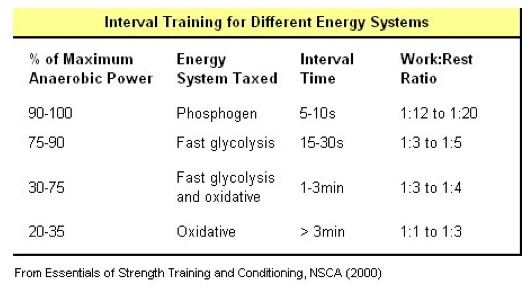
When we perform sprints for our hockey players we will start out with longer, less intense reps early in the off-season and finish with shorter, more intense reps towards the end of the off-season.  I’ll always remember the words of a mentor of mine who said, ‘the longer the interval the shorter the rest’ and ‘the shorter the interval the longer the rest’.  This is such a basic statement but unfortunately gets forgotten near the end of the off-season.  Consider the following table.

A shorter interval lasting 10 seconds could require up to 3 minutes 20 seconds recovery time with a 1:20 work to rest ratio.  However a one minute effort may require between 3 and 4 minutes for recovery with a 1:3-1:4 work to rest ratio.  The longer effort has a shorter recovery compared to the shorter effort based on work to rest ratios.

At first this may seem counter-intuitive but once you experiment with your work to rest ratios a little you’ll understand the truth behind it.  The reason for this is that the longer, less intense and more aerobic a drill is the more quickly you can recover from it.  The shorter the duration, the more intense and the more it taps into the anaerobic and ATP-PC energy systems, the longer it will take you to replenish these energy systems and recover.

But there is another key reason to be patient with your speed drills near the end of the off-season.  The reason is to allow full nervous system recovery.  For a lot of hockey players their ability to generate speed and power is limited by their nervous system.  They may achieve cardiovascular system recovery.  And they may achieve muscular system recovery.  But the nervous system may take more time so it is essential to be patient after each effort and ensure complete recovery.  The best way to explain this to your hockey players is that each effort must match or exceed their previous effort.

Bonus tip
There’s something I like to do with our hockey players at the end of every speed session and we’ll even include it earlier on in the off-season as well.  I like to call it ‘re-setting the clock’.

What this means it performing one last effort that is guaranteed to beat all previous efforts.  This may mean performing a shortened version of a drill.  Or this can be done by performing the last drill as a competition to up the intensity.  Lastly you could perform the drill with an assist such as a slight decline or a harness.  You are only limited by your creativity in terms of ways to provide the hockey player with the opportunity to exceed their 100%.

And why does this matter?  Very few speed sessions and almost no conditioning sessions end with the hockey player demonstrating their top gear.  And guess what happens when you train below your top end speed?  You compromise your speed.  But if your last effort is your best one you ‘reset your internal clock’ and provide your nervous system with a new definition of speed.

Keep these tips in mind regarding work to rest ratios and remember to ‘reset the clock’ at the end of every workout.

Chris Collins M.Sc. CSCS
Onside Hockey Training

References:

  1. Burr, JF, Jamnik, RK, Baker, J, Macpherson, A, Gledhill, N and McGuire, EJ. Relationship of Physical Fitness Test Results and Hockey Playing Potential in Elite-Level Ice Hockey Players. Journal of Strength & Conditioning Research 22(5):1535-1543, 2008.
  2. Baechle, TR and Earle, RW. (Eds.). (2000). Essentials of Strength Training and Conditioning (2nd ed.). Champaign, IL: Human Kinetics.

To your success,

Kevin Neeld

Please enter your first name and email below to sign up for my FREE Athletic Development and Hockey Training Newsletter!

Use CODE: "Neeld15" to save 15%