Before jumping into today’s post, I just wanted to say a quick congratulations to several of our athletes from this off-season.

  • John Gaudreau (’93) is tied for 2nd on his team (Dubuque Fighting Saints) and tied for 3rd in the USHL for points, as a first year player!
  • Matt DiGirolamo was awarded the starting goalie position at UNH this year and is off to a great start. Check out this article: New Hampshire’s DiGirolamo a blast from the past for Umile
  • Colby Cohen played his first few games in the NHL over the last week and played quite well. Colby worked extremely hard with us at Endeavor all Summer. The gains he made are clearly helping him on the ice.
  • Eric Tangradi scored his first NHL goal a couple weeks back and looks bigger and faster on the ice than ever. great on the ice.

We’re really proud of the hard work these players have put in with us at Endeavor and also on the ice with their respective teams. Keep up the great work guys!

As you may know, I’ve spent a lot of time researching topics related to hip and lower abdominal injuries. Because injuries like hip flexor strains, groin strains, hip labral tears, and sports hernias are affecting an increasing number of players (and receiving an increasing amount of attention), I feel it’s important to do whatever I can do prevent these injuries in our players. Over the last couple years at Endeavor, we’ve pretty much eliminated hip flexor injuries altogether, and have been able to quickly restore balance in players suffering groin strains (almost always in players that refuse to take any time off the ice).

Sports hernias and labral tears can be a bit of a different scenario because surgery is an option, and one heavily pushed by most docs. This raises the debate, “Should ‘strength coaches’ be involved in these types of injuries at all or strictly leave them to surgeons/PTs?” It’s an interesting debate, but one we’ll leave for a different discussion. Over the Summer, we had a player come to us with the following situation:

  • LONG-term adductor/groin pain (several years!), in the area of the adductor longus (as expected)
  • Showed other symptoms of a sports hernia (notably painful during movements that stretch the rectus abdominis)
  • Painful during ALL movements, even jogging
  • No health insurance
  • 5 weeks to train


Goal # 1: Do everything you can to avoid this!

The reason I said we’ll leave the surgery debate for another time is because, without insurance (or shelling out $10,000 in cash), surgery wasn’t an option at all. Nor was seeing a physical therapist for that matter. Admittedly, the situationw as a little intimidating. He had 5 weeks to be symptom free AND to be ready to step on the ice for a new professional team in London, England. With that time course, there is no room for “I think this should work”; you get one shot. I spent quite a bit of time writing his program, and reached out to three incredibly bright coaches/mentors of mine: Eric Cressey, Michael Boyle, and Charlie Weingroff, all of whom provided invaluable insight into the situation.

A couple take homes were:

  • Don’t do ANYTHING that was painful (even mildly painful). In this situation, this meant NO lateral movement (including lateral squats, shuffling, slideboarding, amongst others), no reverse lunges or back leg raised split squats, and no skating!.
  • Focus on restoring balance across the hips. In this situation, this meant restoring length across the anterior hip, loosening up the glutes, and focusing most of the strength work on the posterior chain.

Compared to other off-season hockey training programs, this didn’t leave us with a ton of options. Naturally, we HAMMERED the soft-tissue work for the anterior and interior thigh compartments and also the glutes. We quickly progressed him from a foam roller to a PVC pipe, which gets a bit deeper because of it is so much denser.
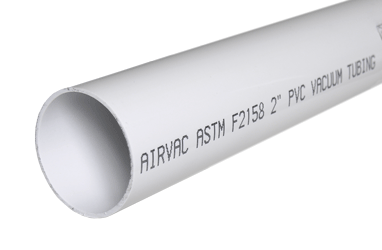

PVC Pipe: An injured hockey player’s best friend.

The two areas I wanted to dive a bit deeper into are the stretching (geared towards adding length to the muscle) and the conditioning.

Stretching: Adding Sarcomeres in Series

Because one of the major focuses was to restore alignment, we used several stretches repeatedly:

  1. 1/2 Kneeling Hip Flexor Stretch w/ Downward Foot Press
  2. 2-Way Rectus Femoris Stretch w/ Downward Foot Press
  3. Stability Ball Internal Rotation Stretch
  4. Prone Active Hip Internal Rotation Holds
  5. Seated Glute Stretch
  6. Med Ball Loaded “Y” Stretch

Again, the goal here was to open up the anterior hip (remove some of the anterior tilt), improve hip internal rotation, and increase his ability to extend through the thoracic spine. The “Downward Foot Press” is a strategy we used to increase the tension in the stretched muscle in order to stimulate adding actual length (sarcomeres in series) to the muscle. We also had him hold the 1/2 Kneeling Hip Flexor Stretch for 5 mins on each side for the same reason. Stimulating actual muscle length is achieved through prolonged time in a stretched state and/or tension in a stretched state. After several weeks of this, he said his helps felt a lot looser, and his groin pain was starting to subside a bit.

Conditioning: How to stay in good shape when every movement hurts

How do you condition a hockey player when he can’t skate, run or slideboard, and you don’t want him to bike because of the concern of further exacerbating his already substantially shortened hip flexors? There are a couple options left, but the two that suited our purposes the best were:

  1. Forward Sled Marches
  2. Med Ball Circuits

On our sticky track, it typically takes around 25-30s to march a sled 25-yards to the end of the track. This made it pretty easy to build in an interval training component to his program. Because his body orientation while marching with the sled didn’t necessitate extreme hip flexion, he was able to perform the exercise pain free. Two wins.

Med Ball Circuits were a no brainer. High intensity, maximum velocity rotational movements are a must for off-season hockey training programs anyway. Devising a circuit to incorporate these was another great way to get some extra valuable work in while also improving his conditioning. The circuit was:

  1. Overhead Med Ball Slams: 12x
  2. Front Standing Med Ball Scoops: 10x/side
  3. Side Standing Med Ball Shot Put: 10x/side
  4. Underhand Med Ball Scoops: 12x

We’d have him perform the circuit anywhere from 3-5x, depending on the week.

At this point, you’re probably wondering what the outcome of all this was. After all, understanding these strategies is only worth your time if they worked. Last week he sent me a quick message to update me on how things are going. He said he’s been completely pain free all season (first time in years!), and he’s currently the second leading scorer on the Newcastle Vipers (EIHL).

A few important take homes from this experience:

  1. Many injuries that are typically thought to warrant surgery can be treated conservatively if done right
  2. A crucial factor in alleviating “soft-tissue” injuries is to avoid anything that irritates it
  3. EVERY PLAYER NEEDS TO TAKE TIME AWAY FROM THE ICE EVERY YEAR!
  4. Having a network of experienced professionals in your field is invaluable
  5. Studying injury risk factors can have a profound impact on your athlete’s careers. It’s worth your time.

To your success,

Kevin Neeld

Please enter your first name and email below to sign up for my FREE Athletic Development and Hockey Training Newsletter!

Some great new additions to Hockey Strength and Conditioning this week from coaches that have a profoundly successful history training pro hockey players:

Video: TRX Lateral Line from Sean Skahan
Coach Skahan presents an interesting core training exercise using the TRX. This was one of those videos that gave me ideas for a half dozen other exercises. Great stuff.

Program: Phase 2 for an NHL or College Player from Michael Boyle
A sample training program for elite level players from a coach that has trained more elite level hockey players than anyone else in the world. Not a bad resource to look at!

Article: VO2 Max Testing from Jaime Rodriguez
Jaime is currently working as the Strength and Conditioning Coach for the Worcester Sharks, the AHL affiliate for San Jose. This is a great article addressing the appropriateness/importance of using VO2 as a quantitative measure for hockey players.

Article: How do you customize or individualize a workout for a hockey player? from Mike Potenza
Coach Potenza outlines how, why and when to customize training programs for specific individuals. This is a great look into his personal coaching philosophy, which has developed from years of education and experience.

If you aren’t a member yet, you’re missing out big time! The forums have been as busy as ever with great content, including a post with heart rate data from an elite level player during a game, and a grad student inquiring about NHL/AHL internships. For less than $10/month, you won’t find more powerful content anywhere.

Click the link below for more information about Hockey Strength and Conditioning!

To your continued success,

Kevin Neeld

Please enter your first name and email below to sign up for my FREE hockey training newsletter!

Over two years ago, Randy Pausch, a Carnegie Mellon professor, gave what was known as “The Last Lecture”. If you were living under a rock during that time period and missed his lecture, set aside 75 minutes to watch the video below. It may be the most powerful thing you’ve ever seen:


Recently, I received an email from Hockey Parent of the Year (whom I announced last week!) Cristi Landrigan with another very powerful video…from an extremely unexpected source. Cristi’s message (because the email was also sent to her children, amongst others) said:

“Guys….if you have time to poison your brain with Jersey Shore, you have time to watch this.”

Having poisoned my mind on several occassions throughout this season of the Jersey Shore, I felt an obligation to heed Cristi’s recommendation. Take another 10 minutes to absorb some of Will Smith’s wisdom.


These are two videos that I think every person should watch. The latter is especially pertinent to aspiring athletes.

When I hear how many people respond to watching Randy Pausch’s video with “he was so brave”, I’m concerned that they may have missed his point. I’m not discounting his bravery. To come face to face with inevitable death and not lose your smile is an incredible act of bravery. With that said, he never claimed to be a symbol of bravery. In fact, his point was quite the opposite. He did not succumb to fear and sadness because he CHOSE not to. He acknowledged that he had the power to decide how he wanted to respond to the situation and he chose to respond by maintaining his happiness. This power of choosing an interpretation to a situation is one that EVERYONE possesses, but few choose to accept/practice. Frankly, it’s easier to blame circumstances than to accept the responsibility of being able to choose your reaction.

Will Smith had a similar, but slightly different message. He repeatedly alluded to the fact that we’re capable of anything we want. The only time that wasn’t true was when we didn’t think it could be. The X-factor in achieving seemingly lofty goals, is an unwavering focus and drive to make consistent progress toward their achievement.

The big take home message:

Where you are now isn’t where you need to stay. You can achieve anything you want if you believe you can and work toward it consistently. Regardless of your current situation, your happiness is a choice you make, a responsibility you have, a power you possess.

I come across countless youth players (and their parents) who are ready to throw in the towel at anywhere from 11 (yes, 11!) to 14 years of age because they didn’t make a certain team or aren’t getting a ton of ice time on that team. Unfortunately the hockey world isn’t always the most supportive, and early talent development in certain players can be discouraging for players that develop later. If there’s one thing I wish I could convince every youth player it’s that you are far from fulfilling your full potential. The road to elite level hockey is paved for some athletes and covered in 4ft of snow for others. Your work ethic, determination, focus, and dedication to skill development will determine your future, not the insults of a teammate or misinformed youth coach. I still think back to a conversation I had with Eric Tangradi several months ago where he referenced an individual I won’t name telling him he would never be anything in hockey when he was younger. This was/is a well-respected coach. Eric scored his first NHL goal a couple weeks back. Turns out Eric’s dreams and determination were more powerful than that coaches interpretation of his abilities as a young player.

To your success,

Kevin Neeld

P.S. “Being realistic is the most commonly traveled road to mediocrity.” -Will Smith

Finally, the Secrets of Elite Level Hockey Development are Revealed!

Click the image below to discover how you can benefit from over 150 years of collective hockey development experience from 14 of the world’s top experts!

Please enter your first name and email below to sign up for my FREE Athletic Development and Hockey Training Newsletter!

Last week I had a Tier I U-18 player stop in at Endeavor so I could have a look at his hip. I tend to do these types of favors for players that have trained with us in the past and/or play for coaches that I know (in this case, Jared, my boss at Endeavor).

In these situations, my first question is always, “Have you seen a physical therapist about this?”

This is an important first question to ask because they may have already received a diagnose and/or treatment strategies that will provide some insight into what’s going on. It also helps protect me professionally from stepping on the toes of a profession that, in general, is better suited to handle sports injuries.

With that said, this player had been to a physical therapist who (in his words) “showed me a few stretches for my groin.” Naturally, these didn’t help.

As you know, I’m almost ALWAYS against stretching a strained muscle. In most cases, I think it will make the injury worse. In general, strains tend to occur in areas that move excessively and in muscles that aren’t strong enough to accommodate the workload. In many cases, the strained muscle simply lost a “stiffness” battle with a synergistic muscle. This means that the synergistic muscle would likely need the stretching and the strained muscle would likely need strengthening.

Moving away from injury generalities and back to the case at hand, I went through the normal process of asking him what happened and how long it’s been bothering him. Not surprisingly, he pointed to the inguinal triangle as his area of pain. Because the adductor longus is the most frequently strained groin muscle, I was expecting this area to be painful.

I did a quick search for “groin pain” pictures and this came up. I’m not sure why exactly, but to find out I will have to personally assess each and every one of them! (…just kidding Emily)

I did a simple prone and supine hip internal and external rotation ROM assessment, and this revealed something interesting. He had great ROM in both directions on his unaffected side. On his affected side, he had slightly less internal rotation than his other side, but SUBSTANTIALLY more external rotation. As a follow up, I did Craig’s Test” on his affected side, a test that assesses for femoral anteversion or retroversion.

Interestingly, he had a positive Craig’s Test (>15 degrees), which typically is accompanied by excessive internal rotation and limited external rotation (quite the opposite of what we found). I also performed a Thomas Test to assess hip extension ROM, which was positive (limited hip extension, indicative of a hip flexor restriction) on his uninjured side, but negative/normal on his injured side. While this could be interpreted as a good thing (how could full hip extension ROM be bad?), putting it within the context of the rest of our findings painted a drastically different picture.

In this case, the full hip extension is indicative of anterior hip capsule laxity. Basically the ligaments have become overstretched, which allows for both full hip extension and excessive external rotation. In light of a damaged anterior hip capsule (which provides a “check” to hip extension and external rotation), it’s of no surprise that the muscles that also provide a “check” to hip extension and external rotation (the hip flexors/adductors/internal rotators) would be overworked, and (almost inevitably) injured.

Stretching these muscles would be exceptionally counterproductive. My approach was:

  1. STOP stretching the adductors
  2. Strengthen the anterior glute medius to help return some muscular support to the anterior hip capsule (a concept from the Postural Restoration Institute)
  3. Seek treatment from a great manual therapist (in this case, Dr. Tancredi in Broomall, PA)

I often hear people make the argument that certain things (notably the above example) are more in the realm of a physical therapist’s job description than a strength coach’s. I don’t disagree. I don’t necessarily view my role as “diagnosing and treating injuries”, but it’s helpful to have an understanding of some of the tests that PTs use so I can get an idea of what is going on with our injured athletes. This doesn’t give me the go-ahead to treat them, but allows me to make the most appropriate referral and clearly communicate the situation with that professional.

As a closing note, if you’re a player, the big take home from this is to get your injuries checked out immediately. This player hasn’t played in a couple weeks now, and this is the season he’s supposed to finalize an agreement with an NCAA D1 team. I understand you’re a hockey player so you’re supposed to be tough and not feel pain and fight through injuries and all that crap. You’re also not supposed to be a moron and miss several weeks/months of a season because of a minor injury that got out of hand as a result of your stubbornness. If your going to fight through injuries, October/November isn’t the time. Save the tough guy mentality for playoffs.

Kevin Neeld

Please enter your first name and email below to sign up for my FREE Athletic Development and Hockey Training Newsletter!

This was a really cool week at Hockey Strength and Conditioning. Last week I mentioned that the content slowed a bit, at least in the form of programs, articles, and videos, but that I really got a lot out of the forum discussions. This week was almost the exact opposite-TONS of new stuff added.

Webinar: Case Study-Pro Hockey Player from Jim Reeves
Admittedly, I don’t know much about Jim Reeves other than knowing that people I speak very highly of speak very highly of him. This webinar was a great introduction to his experience, philosophies and methodology. He presents Pre- and Post-FMS scores for the same player across two-consecutive off-seasons, details the player’s dysfunctions and impairments, and shows EXACTLY what he did to restore function and rebuild performance. This will be one of those resources that takes me a few viewings to truly let everything sink in. Great stuff!

Video: More Dryland Skating Exercises from Mike Potenza
This has been a popular topic on the site for the last several weeks, and one that I find especially interesting. From a training standpoint, I go back and forth on how important these exercises are. There is a large specificity component to training skating-like movement patterns off the ice; on the other hand, players should be spending time working on these things ON the ice. I don’t think an entire training program should be built around these, but including them as 5% of your program under the umbrella of hip stabilization or work capacity exercises (depending on the exercise and how you implement it) is a great idea. Getting athletes to buy-in to your programs ultimately decides the results they will get. Including exercises that hockey players will clearly see an on-ice translation will help with buy-in. That was a long-winded way to say that I think having a variety of “skating exercises” to pull from will keep things interesting for the players, and Coach Potenza presents a lot of great choices in this video series.

Program: Pre-Game Warm-Up from Sean Skahan
Great dynamic warm-up from Coach Skahan that players of all ages could use to best prepare for their game (or practice for that matter). This is very similar to warm-ups I’ve used in the past with my players. In the accompanying text Coach Skahan mentions that some players that have gone through this with him continue to use the exact same warm-up, despite having moved to a different team. In my opinion, that’s one of the greatest testaments to a quality warm-up (or program), when players continue to do it because they see the benefit, not just because they have to.

Article: RFE Progressions from Devan McConnell
Like we do at Endeavor, Devan uses the “Rear Foot Elevated Split Squat” as a foundational lower body lift for his athletes. This is a great six-step progression for athletes that have trouble mastering the “back squat” bar position right away.

Getting the Most Out of Your Hockey Strength and Conditioning Membership!

By now, you’ve likely experienced the huge benefit to getting access to the information at HockeySC.com every week. In addition, there are two other things you can do to improve your experience:

  1. Network on the site by posting something on the “Introduction” thread on the forum, and by asking well-thought out questions on other forum threads. There are a lot of “big names” in strength and conditioning that check the site regularly. Whether your goals are hockey-specific or not, this is a great place to meet professionals that can help you advance your career.
  2. Check out contributor’s youtube channels. I get a lot of great ideas from watching other coach’s exercise videos. The articles provide a great opportunity to hear the coach’s rational for using certain exercises and learn how they integrate them into their program. Because many of the coaches use youtube as their video hosting platform, you can get access to ALL of their public videos by clicking directly on the video while it’s playing. You’ll be redirected to their youtube channel, which you can then subscribe to. I actually have two youtube channels (“EndeavorPerformance” and “HockeyTrainingCoach”) that I post videos to pretty regularly. I recommend you subscribe to as many quality channels as you can to get new ideas on a regular basis!

Click the link below for more information about Hockey Strength and Conditioning!

To your continued success,

Kevin Neeld

Please enter your first name and email below to sign up for my FREE hockey training newsletter!

Use CODE: "Neeld15" to save 15%