I’m exceptionally fortunate to have access to a wide variety of training equipment at Endeavor. Our facility is basically like training facility playground. With few exceptions, anything that resides in the Perform Better catalog that I think will allow us to get better results with our athletes, we have. One piece of equipment that I didn’t have much experience with before coming to Endeavor is the Vertimax platform.


Because ice hockey is primarily a horizontal-based sport, my initial thought was that I wouldn’t have much utility for the two Vertimax platforms that Endeavor was equipped with. I was wrong. We use the Vertimax a lot with our hockey players. I put together a short video on how we integrate the Vertimax into our hockey training programs for the Vertimax company. You can check it out below:

To your success,

Kevin Neeld

Please enter your first name and email below to sign up for my FREE Athletic Development and Hockey Training Newsletter!

In preparation for our Endeavor Staff Meeting last week, I spent a couple hours reading new research related to hockey players. Much to my surprise (because not a lot of research is done on the hockey population), there was actually some pretty interesting stuff out there. Check it out:

Laterality differences in elite ice hockey: An investigation of shooting and catching orientations

I wouldn’t say this is “groundbreaking”, but it’s intriguing. This study found that right-handed players were better goal scorers, left-handed players were better playmakers, and that there was an increase in left-handed goalies at higher levels (I always hated shooting on lefty goalies as a player!). Obviously, this isn’t to say that leftys can’t score goals and rightys can’t make passes, only that there is a tendency for more of the opposite to occur.

A 7-year review of men’s and women’s ice hockey injuries in the NCAA

The rate of concussion was 0.72/1000 exposures for men and 0.82/1000 for women, and the rate remained stable over the study period. Player contact was the cause of concussions in game situations for 41% of women and 72% of men. This goes to show that concussions are AT LEAST as big of a problem in women’s hockey as they are in men’s. Strength, speed, and awareness are the best ways to combat these!

Complex training in ice hockey: the effects of a heavy resisted sprint on subsequent ice-hockey sprint performance

This study found that performing a single heavy sled-resisted sprint on the ice was sufficient to improve 25-m on-ice sprint times. With my background in neuroscience, this isn’t surprising. Heavy training results in an increased neural drive to the working muscles. This does provide an on-ice training application for power skating work though. By performing heavy sled-resisted sprints, resting for a few minutes, then performing an unloaded sprint, you can train the body to use a greater proportion of the skating muscles’ capabilities to operate at higher velocities. The key is to provide ample rest between the two bouts (2-3 minutes), and not just run the players into the ground. Sean Skahan wrote a great post on this on his site: Complex Training in Hockey

Cellular responses in skeletal muscle to a season of ice hockey

This was the one that really stood out to me. The authors took metabolic enzyme samples from the vastus lateralis (lateral quad muscle) pre- and post-season and parlayed these findings to adaptive changes that occur in the muscle across the season. The result was “a smaller (p < 0.05) cross-sectional area (CSA) for both type I (-11.7%) and type IIA (-18.2%) fibres and a higher (p < 0.05) capillary count/CSA for type I (+17.9%) and type IIA (+17.2%) were also found over the season. No changes were found in peak oxygen consumption (51.4 ± 1.2 mL kg(-1) min(-1) vs. 52.3 ± 1.3 mL kg(-1) min(-1)).” This led the authors to conclude that “based on the alterations in oxidative and perfusion potentials and muscle mass, that the dominant adaptations are in support of oxidative metabolism, which occurs at the expense of fibre CSA and possibly force-generating potential.”

Taken at first glance, these findings would seem to question the “hockey players don’t need aerobic training” argument. A slightly deeper look at this information shows that the authors didn’t demonstrate an absolute increase in capillary count, only an increase in capillary count PER cross sectional area of the muscle fibers. In this regard, it’s especially relevant that cross sectional area decreased significantly in both Type I and Type II fibers. This means that capillary count could have also decreased, but decreased RELATIVELY LESS than the cross sectional area of the muscle fibers. I also think it’s important to note that these findings were from one muscle only, and it’d be difficult to make body-wide assumptions based on these findings.

At the risk of sounding stubbornly narrow-minded regarding my opinion on conditioning for hockey players, I think this study just further highlights the need for in-season training to maintain muscle mass. 12% and 18% decreases in the cross-sectional area of Type I and Type II muscle fibers, respectively, is pretty substantial! I’d be interested to see how the findings in this study would change if muscle mass was maintained throughout the season. I’d also be interested to see how the strength profiles of these players changed.

Risk Factors for Groin Strains in Sports from Mike Reinold

Mike Reinold is a really bright guy and I’ve enjoyed reading his work for the last several months. In this post he highlights a study on soccer players indicating that the top two risk factors for groin strains are previous strain and adductor weakness. If you’ve been following my work for a while this won’t be news to you, but it’s nice to know that the research community it continuing to find that this is the case. The more evidence we have that these are the two most common factors, the more convinced we can be that we’re on the right track by taking steps to maintain adductor strength and prevent initial injuries form occurring in the first place.

Last, but certainly not least, I think Body By Boyle Online has RAPIDLY established itself as one of the top strength and conditioning resources available. What started as a site to deliver the training programs used by Michael Boyle Strength and Conditioning to establish itself as the #1 Gym in America has expanded to include an incredible amount of information, including some of Boyle’s top presentations, and presentations from Sue Falsone (Physical Therapist from Athletes Performance) and my friend Nick Tumminello. When the site first came out, I thought it was a great option for individuals that wanted to follow a structured training program, and for strength and conditioning coaches that wanted to take the guess work out of program design for their clients. Now I think it’s a must-have for all strength and conditioning professionals. I’m blown away that they’d put so much content on the site and still only charge around $60/month to access it. Click the image below to head over to the site and see everything they have to offer.

To your success,

Kevin Neeld

Please enter your first name and email below to sign up for my FREE Athletic Development and Hockey Training Newsletter!

Content was booming this week at Hockey Strength and Conditioning! Check out what you’ve missed:

Article: Neck Strengthening for Hockey from Sean Skahan
I really like Sean’s philosophy on how neck training can manifest in the form of exercises you may not suspect. In addition to the videos he includes, there is a lot of other great information in this article pertaining to concussions and the process of returning players to the ice. Great read.

Article: Producing Elite U.S. Players Starts at Bottom from John Buccigross
FINALLY! Someone with a huge audience (other than the HockeySC.com team) discusses what true hockey development is all about. It’s been interesting to see how hockey has developed in the U.S. over the last 15 years. USA Hockey is taking a lot of great steps to improve their development model. The impression I get is that Canada, believe it or not, is starting to recognize that they’re headed down the wrong path and will start to make similar changes in the somewhat near future. File this under the “Must Read” category.

Article: The Disconnect of the Culture from Jim Reeves
Another brilliant article on the importance of developing athletes first, hockey players second if the goal is to pursue elite level competition. Interestingly, but not surprisingly, we had two stud goalies train with us this summer at Endeavor that were also very competitive baseball players. Baseball-characterized by short bursts of high velocity power generation and reactivity. Goaltending-characterized by short bursts of high velocity lateral movements and reactivity. Coincidence?

Article: From the Ground Up from Dan John
Dan John is a legend in strength and conditioning. I’m really looking forward to hearing his presentation(s) at the MBSC Winter Seminar this year. When in doubt, return to basics. This article serves as a reminder that a simple, well- and consistently executed program is better than a haphazardly performed complex program.

Program: In-Season Lifts: Core Movements, Strength Movements and Complexes from Mike Potenza
Mike put together a great exercise library, divided by movement pattern/emphasis, that he uses to train the Sharks in-season. Similar to Dan John’s article, this provides some insight into what you NEED to perform if you’re extremely limited on time, as most in-season players are.

As always, the forum had a few great discussions this week. I particularly liked Maria Mountain’s response to the “Career Guidance” thread so check that out the next time you sign in.

Click the link below for more information about Hockey Strength and Conditioning! I look forward to speaking with you on the inside!

To your continued success,

Kevin Neeld

P.S. Remember that today is your LAST CHANCE to get my Ultimate Hockey Development Coaching Program for free! Check out this post for details: Rapid Response Goalie Training

Please enter your first name and email below to sign up for my FREE hockey training newsletter!

The last couple times I’ve talked to my friend Nick Tumminello on the phone, he’s mentioned that most writers are talking mostly about things like core training or corrective exercise and that the art and science of program design seems to be somewhat lost in these discussions.

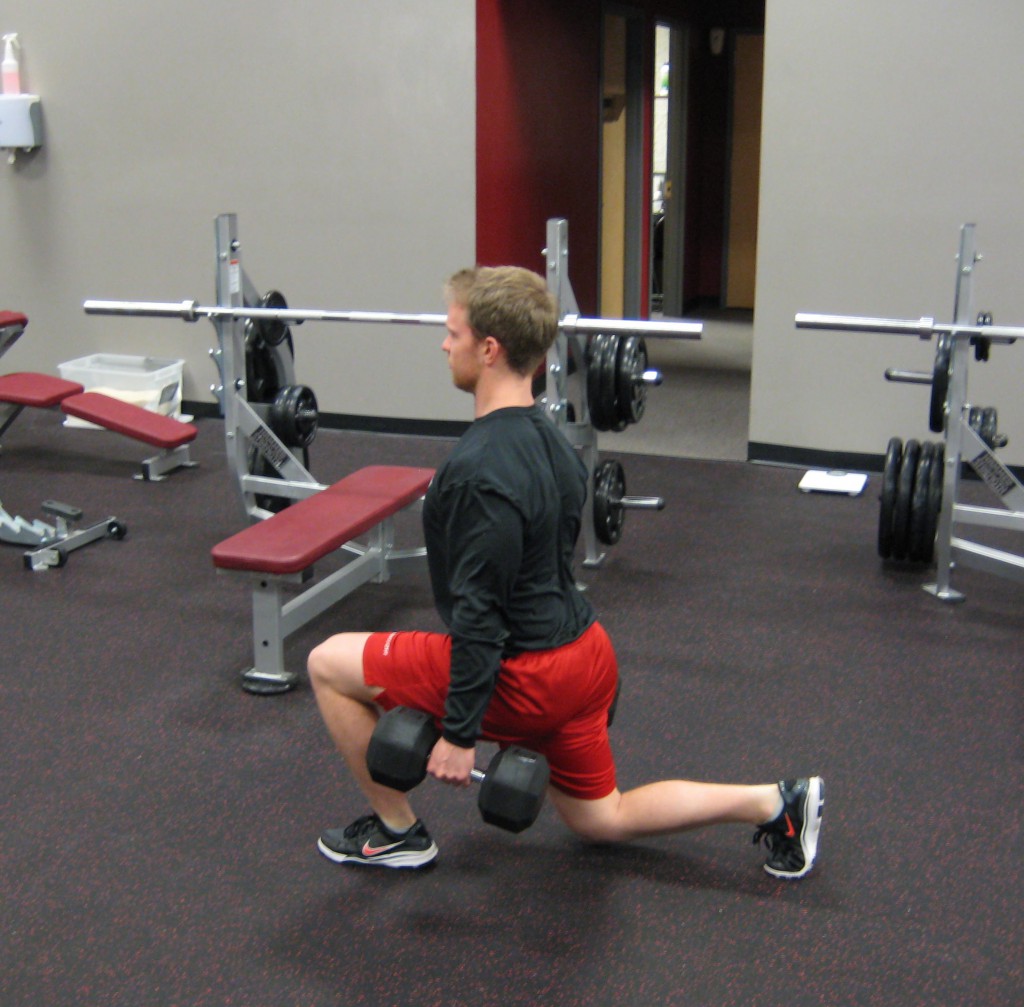
To his point, the intensity and volume of the exercises is equally as important as the exercise itself and the manner in which these parameters are varied determines adaptation or stagnation. As a simple example, if a beginner does Reverse Lunges for 3 sets of 6 on each side with 20 lb dumbbells, they’ll get stronger up a point where that becomes easy and then they’ll plateau. Despite performing a great exercise, they’ll eventually stop building muscle, improving strength, and/or augmenting work capacity.
It’s somewhat commonly accepted that it’s necessary to rotate exercises every so often so your body doesn’t plateau. I think a more accurate recommendation for this “necessary variation” is that the loading parameters for any given exercise needs to be regularly adjusted so the body doesn’t plateau. With the exception of highly trained lifters (~ 5+ years of consistent training), most people can continue to make gains with the same exercises by altering only the loading parameters and may be hindered by excessive variation in exercise selection.

Loading can be altered through:

  • # of sets per exercise
  • # of repetitions per set
  • Load used for the exercise
  • Length of rest periods

The term periodization, at its core, simply means variation. There are endless periodization models that coaches follow with varying levels of enthusiasm. A common argument is whether a linear periodization model is sufficient for most athletes. In a linear model, a phase (typically 4 weeks) is geared toward a single quality. For example, the focus of one 4-week phase may be hypertrophy, in which case the recommendation would be do perform 3 sets of 8-12 reps for the main exercises. A subsequent phase would be geared toward another quality, such as muscular strength. Within these phases, load can be increased as the sets become easier for the athlete. The foundational idea of linear periodization is that the body cannot make improvements in multiple qualities at once, so each phase should focus solely on one quality. In general, this model is extremely effective for beginners.

In theoretical contrast, an undulating periodization model alters the loading parameters on a more frequent basis within a training phase. This isn’t to say that a training phase can’t have a major focus (e.g. maximum strength), but the idea here is that no quality should be neglected in any phase. In general, this model is more effective than linear periodization for more advanced lifters. Of interest, undulating models appear to be equally as effective as linear models in beginners (Buford et al, 2007).

Instead of getting into a theoretical discussion on which model is “the best”, the loudest determinant of successful programming is a succesfull outcome. In other words, if the goal is strength, are the athletes getting stronger? If yes, then the program probably works.

At Endeavor, we use an undulating periodization model for all of our athletes. My rationale for this was simple: Because we work with advanced lifters that will need to follow an undulating model to get results, and because novice lifters get equivocal results following an undulating vs. linear model, it makes designing and implementing programs easier to follow a unitary undulating model.

There are countless ways to implement this model, but we generally follow a 4-week approach as follows:

Week 1: Introduction (Accustomization)
Week 2: Increased Volume (Hypertrophy)
Week 3: Decreased Volume; Increased Intensity (Maximum Strength)
Week 4: Deload (Recovery/Adaptation)

The set and rep schemes within this frame can be shifted to give a training phase a higher hypertrophy or maximum strength approach. With this approach, we’ve been able to get athletes very strong, very quickly. Creating a continuous, effective adaptation stimulus is highly dependent upon a strategic manipulation of sets, reps, and intensity. This is one of the reasons I’m so impressed with Eric Cressey’s Show and Go Program. Our entire staff has been on it for the last 6 weeks and we’ve all been hitting personal records in various lifts. In short, it works. Eric is offering $30 off the entire system until midnight tonight. If you act quickly you can get Eric’s program at a substantial discount and start getting bigger and stronger, immediately! Click the image below to get started today.
References:

Buford, T., Rossi, S., Smith, D., & Warren, A. (2007). A comparison of periodization models during nine weeks with equated volume and intensity for strength. Journal of Strength and Conditioning Research, 21(4), 1245-1250.

To your success,

Kevin Neeld

Please enter your first name and email below to sign up for my FREE Athletic Development and Hockey Training Newsletter!

Last week I presented a special offer for you. If you pick a copy of Maria Mountain’s Rapid Response Goalie Training Program, I’ll throw in FREE copies of:

  • My Ultimate Hockey Development Coaching Program
  • My Breakaway Hockey Speed eBook and all the videos
  • Kim McCullough’s Mental Performance Training Package

In case you missed the post, you can check it out here for more details: Rapid Response Goalie Training

On Friday, I wrapped up a lift that included a Front Squat PR:

and had an opportunity to talk to Maria on the phone for a bit to catch up with her about her experience at Stuart McGill’s 16-hour weekend seminar and about her new Rapid Response Goalie Training Program.

Take 20 minutes to listen to the interview by either clicking the play button on the player below or downloading the raw MP3 file. Amongst other things, we talk about:

  1. A few of the big take homes from the McGill seminar and how they’ve changed aspects of Maria’s training
  2. Common training mistakes that goalies are making
  3. What the Rapid Response Goalie Training Program is all about, including if it’s for you and what makes it different from previous programs of hers

Hockey Training Interview with Maria Mountain

To your success,

Kevin Neeld

Please enter your first name and email below to sign up for my FREE Athletic Development and Hockey Training Newsletter!

Use CODE: "Neeld15" to save 15%