A few years back I heard Mike Boyle describe the primary goals of a strength and conditioning program as:

  1. Prevent injuries to the athletes during the training process
  2. Minimize injury risk during sports practice and competition
  3. Improve performance

This list is presented in order of importance and represents a philosophy that I’ve completely adopted at Endeavor Sports Performance. While a quality training program will almost completely negate training-related injuries and can drastically reduce sport-related injuries, sometimes injuries still happen. Sometimes players take contact while in an awkward position, which can cause injuries like MCL/ACL tears and shoulder separations. While beefing up the musculature in this area can help optimize joint integrity, the truth is that if enough force is applied at the right angle, an injury will still result. That said, injuries don’t need to shut down your training and development. Monday’s post talked about what hockey players can do to keep making progress despite having an injury. If you missed it, you can check it out here: Training Around an Injury.

Today I want to focus on the first point from Boyle’s list, or more specifically, two recent changes we’ve made at Endeavor to keep in line with this philosophy. Naturally, getting hurt while training is a worst case scenario. This is especially true at higher levels of competition (Major Junior, NCAA D1, Pro) where players have career changing exposure opportunities and/or money at stake. At these levels, it’s extremely important to keep the risk:reward ratio of various training strategies in mind. Is it worth the associated spinal compression and overall physiological stress to get an NHL player’s front squat from 325lbs to 335lbs? Will that make him a better player on the ice? What if he tweaks something in the process? What if something he does during training causes him to miss a week of games (~2 games). If this player makes $2.4 million/year (average NHL salary), two missed games is over $58,500 in lost revenue. While I don’t want to get into the argument about whether professional athlete’s salaries are appropriate, I think it’s important to understand whats at stake for these players.

Severe injuries (herniated discs, ACL tears, separated shoulders, etc.) are worst case scenarios, but they’re also easy to spot. Less obvious, but also undesirable, are minor aches, pains, tweaks, etc. that further tissue stress accumulation in undesirable patterns. If athletes feel something weird while they’re doing an exercise, they’re likely in the wrong place and some accommodation needs to be made. In this regard, we’ve had several players over the last two months tell us that:

  1. Doing back leg raised split squats feels uncomfortable on their ankle (in both possible foot positions)
  2. Doing band-resisted push-ups hurts their wrists

If some cases, discomfort is indicative of a lack of ROM at the relevant joint and that needs to be addressed. However, in these cases it’s more likely the discomfort was due to

  1. Height variations of the players and relatively constant bench heights
  2. Excessive wrist extension stress imparted by the bands

In other words, the exercise is the problem, not the player. To address this, we made a couple simple changes to make the exercise more comfortable for our players.
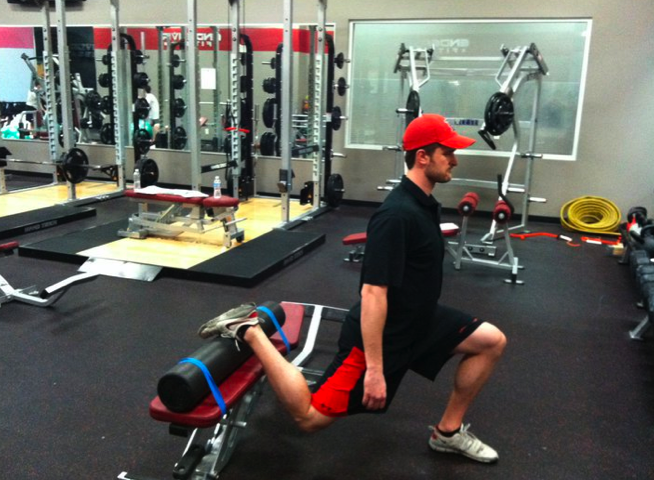
Back Leg Raised Split Squats with Roller

The roller is curved, which allows for better contact with the lower leg/foot. By holding it down with minibands, we don’t need another coach/player to hold it, and it allows for some slight forward/backward movement, which accommodates the athletes weight shift during the exercise.

Band-Resisted Push-Ups with Dumbbells

By wrapping the bands around the dumbbells, the stress on the wrist is removed completely, but the resistance to the torso is maintained. One consideration with this variation is that the dumbbells are raised off the ground, so the potential range of motion for the player will increase. This may or may not be desirable, but is important to keep in mind as some coaching cues may change.

The good thing about these adjustments is that they’ve removed discomfort as a limiting factor for progress (and a thought in our players’ minds). Every coach is going to have a different training approach:

But I think ultimately we all need to share a common philosophy in that our goal is always to put our players/athletes in the best position to succeed. This philosophy transcends all aspects of athletic development, from education to program design to exercise modifications to coaching strategies.

To your success,

Kevin Neeld

Please enter your first name and email below to sign up for my FREE Athletic Development and Hockey Training Newsletter!

Well, it saddens me to say this, but the Flyers playoff run is officially over. And with that, so is the beard. I was hoping to make it to the Boston Hockey Symposium for the second straight year with the Flyers still making a run, but I guess it just wasn’t their year (maybe the 5 scheduled surgeries and 3 other probable surgeries have something to do with it?).

Playoff beard…final hours

The good news is I’m feeling rejuvenated from my trip out San Diego last week and have a lot of great content for you over the next few weeks. We added some great stuff to Hockey Strength and Conditioning that you’ll want to check out.

Darryl Nelson wrote an outstanding article on speed training for hockey. While I think that most of the people in the circle’s I run with have a great understanding of speed training principles, I think the topic remains poorly understood amongst the majority of the hockey world. Darryl’s article does a great job of outlining the most important principle in developing speed for hockey and provides several off-ice training methods to facilitate on-ice gains. Short and to the point. Check it out at the link below:

Click here >> Training for Speed from Darryl Nelson

Sean Skahan added a video of a leg circuit he uses with his players in the late off-season/early pre-season. This is a great video because it shows a training option that isn’t equipment-reliant. In other words, assuming movement pattern proficiency, anyone can do this. The important thing is to recognize where it fits into the bigger training picture. For younger players with a short training history, this method may be effective in developing increases in strength and size. For players with an older training age, a circuit like this would be great for developing work capacity in the hips and legs, but won’t help much in the way of strength improvements. This is likely the reason Sean mentions he uses the circuit to transition into the pre-season, where strength improvements take a back-seat in importance to ensuring the player has the work capacity to sustain the impending on-ice demands. Check out the video here:

Click here >> Leg Circuit from Sean Skahan

As always, there are a few great forum discussions that you’ll be interested in. Check out the one on the benefits of power skating instruction (or lack thereof?), a Q&A with Sean about his leg circuit video, and on the Graston Technique (a manual therapy technique that has some distinct benefits for hockey players).

That’s it for today! If you aren’t a member yet, shell out the $1 to test drive Hockey Strength and Conditioning for a week. If it’s not the best buck you’ve ever spent, I’ll personally refund you!

To your continued success,

Kevin Neeld

Please enter your first name and email below to sign up for my FREE Athletic Development and Hockey Training Newsletter!

I get a lot of inquiries about what training program I use. I have training goals that I’m in constant pursuit of, but I also use our staff training programs as an opportunity to experiment with new exercises, progressions, and program design strategies. In today’s post, I want to give you an inside look at a new program design strategy I’ve been experimenting with for the last couple months.

As a preface, one of the problems I battle with is finding the right balance between stress (in the true sense-meaning training, nutrition, work, and all other life-related stresses) and recovery. Simply, I’m far from proficient at walking away from uncompleted work, so I find myself trying to squeeze 25 hours into every day, for months at a time (time flies when you have your head up your ass!).

Sleep…my long lost friend

In the past, I’ve trained 4 days/week on a Lower/Upper split Monday-Thursday and just took Friday-Sunday off. There are some inherent recovery issues with this set-up, but it fill well with my time at Endeavor. About 6-months ago, I changed to a more traditional Monday, Tuesday, Thursday, Friday/Saturday split, which helped with recovery a lot (obviously). I also changed from going Lower, Upper, Lower, Upper to Upper, Lower, Upper, Lower. For me, a really heavy lower body day was completely debilitating for the upper body lift the next day, but the opposite was not true.

All of these things helped, but a couple months ago I made a change to the program that has accommodated both my increasing work demands and my unwavering pursuit of improved strength. I’m not exactly sure how I came across it (I suspect it was from one of Ben Bruno’s “Good Reads of the Week” posts), but I read a great article from Jason Ferruggia suggesting to take a 4-day program, but only train 3 days per week.

Old Schedule:
Monday: Day 1 Upper Body
Tuesday: Day 2 Lower Body
Thursday: Day 3 Upper Body
Friday: Day 4 Lower Body

New Schedule:
Monday: Day 1 Upper Body
Wednesday: Day 2 Lower Body
Friday: Day 3 Upper Body
Monday: Day 4 Lower Body
Wednesday: Day 1 Upper Body
Friday: Day 2 Lower Body

And it goes on like this. This schedule helps recovery for a few reasons:

  • It decreases the total training stress on any given week (3 sessions vs. 4)
  • It decreases the body-part specific training stress for any given two week period (3 vs. 4)
  • It decreases the lift-specific training stress for any two week period (more on this below)

To expand on this latter point, and this was one of the main messages of Jason’s original article, if I have a “primary” lift like a heavy chin-up or deadlift on Day 1 and Day 2, now I’ll only be performing that lift (with maximal loads) every ~10 days instead of every 7. Because these are the lifts that impose the greatest degree of neural fatigue, spreading them out a bit can have a profound impact on recovery.

Naturally, there’s a lot to consider when choosing a training frequency and overall program design schedule. As I alluded to in Program Design for Small Groups, recovery time is dependent upon both relative and absolute training loads, the latter of which will be lower in athletes with a “younger” training age.

This is the first time I’ve experimented with this training schedule and I’ve really benefited from it. I feel better than I did before and have set a few PRs in the process (as has our other coaches following the programs). It looks like I’ll be sticking with this schedule for the foreseeable future, at least until my schedule eases up a bit!

To your success,

Kevin Neeld

Please enter your first name and email below to sign up for my FREE Athletic Development and Hockey Training Newsletter!

Tomorrow afternoon, Emily and I will be hopping on a plane to head to San Diego for a few days of R & R. I’ve been in desperate need of a vacation since about September of last year, so this is long overdue. I’m really looking forward to getting away for a few days.

But before I go, I wanted to follow up my post from the other day on 3 Keys to Successfully Pairing Exercises with another post on program design, but this time for athletes training in small groups. In the constant search for the “perfect program” I think people lose sight of the fact that “perfect” is situation-dependent. In other words, what might be ideal for training one individual athlete may not be ideal for a group of athletes, and what may be ideal for a group in one setting may not be ideal for a group in another setting. There is a lot to consider, which is why it’s important for people to not judge the programs of other coaches until they’ve seen the setting that they work in, and the clientele they work with.

One thing we’ve done at Endeavor Sports Performance to accommodate larger groups and ensure a smooth-flowing session is move to quad-sets with two main, non-competing lifts. An example template of this looks like:

A1) Main LB Lift
A2) Non-Competing Core/Mobility
A3) Main UB Lift
A4) Non-Competing Core/Mobility

This allows us to take a group of 6-8 athletes and break them into two smaller groups. One group of 3-4 would start with A1 and cycle through; the other would start at A3 and cycle through. For Group 1, they would progress as A1-A2-A3-A4, etc. Group 2 would progress through as A3-A4-A1-A2, etc. In this way, we’re able to make better use of our equipment and keep a good training flow, but still abide but the fundamental principles we feel are important.

This isn’t a program design strategy that I would give a universal approval, but there are certain situations where it works great. The more “advanced” an athlete becomes, in terms of their training experience, the less effective this strategy is. Simply, as training experience increases, it becomes increasingly difficult to make substantial gains in size and strength and therefore every aspect of the program needs to be more meticulously designed and implemented. Naturally, this includes exercise order, intensity, and rest intervals.

In contrast, athletes new to lifting (or re-integrating back into a lifting program) and younger athletes in general progress more readily and recover quickly from any individual exercise. This means that the residual fatigue from any exercise, and therefore the deleterious effect on any subsequent exercise, will be inconsequential.Β  I’m not suggesting it’s appropriate to just run young athletes through circuits of exercises haphazardly and without consideration to fatigue accumulation or exercise order; it’s still imperative that athletes are sufficiently recovered, mentally and physically, before starting a new exercise. But given the recovery time these athletes require, altering the starting point of an exercise circuit as described above will not impair their progress in any way.

There are a million ways to skin a cat. The key is to know your athletes, and not lose sight of fundamental training principles.

To your success,

Kevin Neeld

Please enter your first name and email below to sign up for my FREE Athletic Development and Hockey Training Newsletter!

Pairing exercises is a popular program design strategy. It builds in rest intervals between main lifts andΒ  allows athletes to make more effective use of their rest intervals (and therefore of their time in the gym). Basically, it’s a strategy to condense more effective training stimuli into the same absolute amount of time.

Conceptually, pairing exercises to get more “bang for your buck” is an inherently good practice. However, as with all things training, there are right and wrong, or should I say better and worse, ways of implementing this practice. When deciding what exercises to pair, keep these three things in mind:

1) Use Non-Competing Grips
Many primary pulling-based exercises, such as deadlift and chin-up variations and most dumbbell exercises, place a high load on the grip musculature. If the program is designed such that the athlete is pairing upper and lower body exercises, it’s important to alter the stress to the grip so that grip strength does not become the limiting factor in the exercise. As an example, a dumbbell reverse lunge and a chin-up would place a similar stress on the grip. It’s likely that the athlete’s performance in the chin-up would be compromised due to grip fatigue. In contrast, pairing a dumbbell reverse lunge with a loaded push-up or a dumbbell chest press would alter the grip stress and therefore be less likely to have grip strength be the limiting factor. In general, an easy way to avoid this problem is to pair lower body pulling exercises (deadlift variations), with upper body pressing variations, and lower body pressing exercises (squat variations) with upper body pulling variations. There are some exceptions to this, but if you stick with this template you’ll be right more often than not.

2) Emphasize different body parts
It’s important to note that “paired exercises” and “supersets” are not the same thing; at least not the way they’re typically used. Supersets usually refer to combining two or more exercises for the same muscle group (or movement pattern). Paired exercises is a more broad phrase that refers to combining two or more exercises. In this sense, there is usually a “primary” exercise that is the main focus of the pair, and a secondary exercise that is used to emphasize a different training quality or body part. Unless hypertrophy or localized work capacity is your primary training aim, it’s ideal not to combine exercises with too much overlap in emphasized musculature. For example, pairing a squat and a reverse lunge or a slideboard hamstring curl would impair the athlete’s ability to perform both exercises optimally. In full-body lifting days, you can use the template described above (LB pull with UB press, and LB press with UB pull). In lower-upper splits, you can pair the primary lift with a complimentary core exercise. For example, pairing a deadlift with a glute bridge would help ensure optimal glute activation during the deadlift, which would ultimately assist the main lift.

Glutes-Optimal activation is key

3) Don’t Pair Unilateral with Unilateral
Coming back to the idea of pairing LB exercises with UB exercises, using exercises in both categories that have a unilateral emphasis can be counterproductive (e.g. reverse lunge and 1-arm row, or back leg raised split squat and alternate db chest press). There are a number of advantages to using unilateral exercises, but the bottom line is that for most people (e.g. NOT elite level powerlifters that move truly heavy loads) they’re more physically and mentally taxing and take more time to perform. Pairing two unilateral exercises can drain the athlete and slow the overall flow of the training program. Instead, consider pairing unilateral exercises with bilateral exercises. As a full-body training example, you might pair:

A1) DB Reverse Lunge (unilateral)
A2) Loaded Push-Up (bilateral)
B1) Slideboard Hamstring Curl (bilateral)
B2) Standing 1-Arm Cable Row (unilateral)

Take Home
These are just a few important considerations when designing training programs using a paired-exercise system. Ultimately, the most important thing is that the exercises don’t compete with one another. The goal of pairing exercises is to cram more “good” into less time. Keeping these things in mind will make sure you don’t throw the baby out with the bathwater (don’t lose sight of what’s important!).

To your success,

Kevin Neeld

Please enter your first name and email below to sign up for my FREE Athletic Development and Hockey Training Newsletter!

Use CODE: "Neeld15" to save 15%