A couple days ago, I posted the step-by-step process I go through at the beginning of every season to design the off-ice training programs for an entire youth organization. If you missed that post, I’d encourage you to check it out here: Developing A Youth In-Season Hockey Training Model

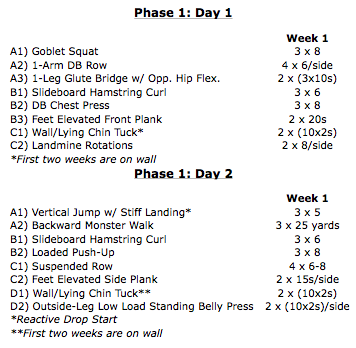
Today I just wanted to follow up with a few sample training sessions for each of the three groups. The purpose here isn’t to necessarily give you a program that you can print and follow on your own (although I do post all of our youth programs for every group every month for Ultimate Hockey Training Insider’s!), but to provide a real-world illustration of the process and concepts discussed in the preceding post.

Group A: 8-11 years old
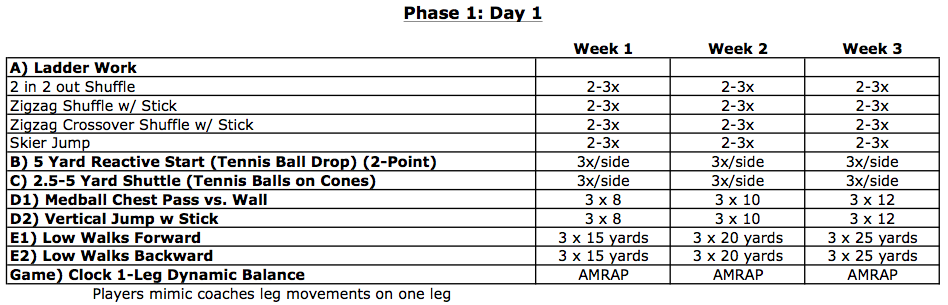
*AMRAP = As Many Reps As Possible

Group B: 12-14 years old
Group C: 15-18 years old
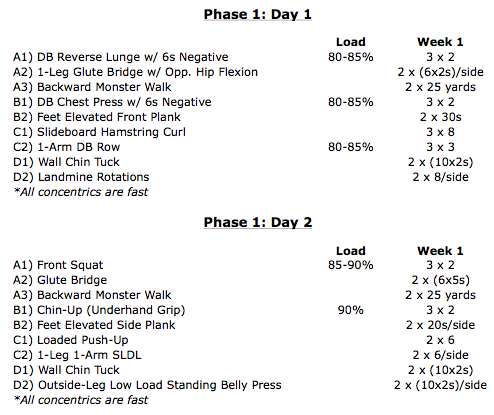
At this point I think it’s important to emphasize that these can be thought of as training templates more so than training programs. All of our coaches (I’m extremely fortunate to work with an AWESOME staff) know how to regress or alter exercises based on an individual’s specific situation. As a few examples:

  1. Group A: Lighter med balls can be used for players that may not possess the strength to accelerate heavier ones
  2. Group A: A Vertical Jump w/ Stick could be regressed to a Drop Squat w/ Stick or simply a Body Weight Squat to help reinforce proper landing mechanics
  3. Group B: Slideboard Hamstring Curl can be regressed to a Glute Bridge On Foam Roller
  4. Group B: Feet Elevated Front Plank could be regressed to a regular Front Plank or even a Front Plank w/ Forearms Elevated
  5. Group B: Suspended Rows can be regressed by having the individual walk their feet away from the attachment of the handles so their body is more vertical/upright
  6. Group C: DB Reverse Lunge can be regressed to a DB Split Squat
  7. Group C: Landmine Rotations can be regressed to unweighted or bent-elbow variations
  8. Group C: Front Squat can be regressed to Goblet Squat

Those are just a few examples for each group, but just about every exercise can be regressed to accommodate individual variation. This is a key component of “individualizing” team-based programs. Another key piece is learning the personalities of the kids to gain a better understanding of what type of coaching strategies they respond best to. All of this, in my mind, is part of the ART of coaching and can really make or break even the most well thought-out off-ice training program. If you’re looking for more information on age-appropriate training guidelines for hockey players, don’t forget to check out USA Hockey’s ADM. There’s a lot of terrific information there that may be more directly applicable to your situation. As always, please feel free to post your comments/questions below!

To your success,

Kevin Neeld

P.S. If want to ensure you’re choosing the right exercise strategies for your team, check out Ultimate Hockey Training, which outlines the exact exercise progressions and regressions to use for every major movement pattern, including multi-directional core training!


Please enter your first name and email below to sign up for my FREE Athletic Development and Hockey Training Newsletter!
One of the things that’s really set our programs at Endeavor apart from our competitors is the fact that we develop systematic, progressive training programs, opposed to just throwing together “workouts” for kids to do on any given day. I heard a great quote several years ago (I believe from Mike Boyle, but don’t hold me…or him…to that):

“Any idiot with a whistle can make kids tired.”

The reality is that many folks (players, parents, coaches, most humans in general) equate being tired with effective training. I always say that you have to move well before you move more, faster, or under load. Skipping this step is one of the reasons why so many players breakdown and suffer muscle strains and other soft-tissue injuries during off-ice (As an aside, we haven’t had a single off-ice training related injury in the last two years while training an entire youth organization). Not to mention, continuing to push and push from an effort standpoint, on- and off the ice, is a recipe for overtraining/underrecovery (one reason why players hit a wall in January/mid-season).

I say all that to say this: strategically planning and altering the off-ice stresses throughout the season will help ensure that players continue to progress athletically, while minimizing the risk of injury and overtraining. This is especially important as players get older for a number of reasons:

  1. Older players tend to have more frequent practices and more games, meaning they’re on the ice significantly more than their younger counterparts. More ice time means more stress to the body.
  2. Older players tend to have more muscle mass and a better developed nervous system that translates into having a higher drive. They have more mass to accelerate, are able to reach higher speeds, and therefore have more mass to decelerate during every shift or practice drill. All of this translates into a greater stress to the body with each practice and game, which requires a greater recovery effort.
  3. The game becomes more physical as the level progresses. In addition to the above stresses, superimposing more frequent high and low velocity contact takes it’s toll on the body.

All of these things explain why the strength and conditioning coaches at the highest levels are as much of “stress managers” as S&C practitioners. In other words, the overwhelming majority of in-season training efforts need to be designed with recovery in mind. One major difference between the highest levels (e.g. the NHL) and top youth levels (e.g. U-18 Tier I Elite League) is that, at least in theory, the NHL is a performance league, whereas U-18 is (or at least SHOULD be) a development league. This simply means that you’re able to push a little more in-season in the interest of achieving higher levels of performance.

Sitting down to design the in-season plan for our youth teams is one of the more fun parts of my job. We’re fortunate to work with an AWESOME group of kids, parents, and coaches with Team Comcast. This allows us some freedom to try new ideas from a programming standpoint, and we have enough communication with the coaches to know when we need to alter some of the off-ice stresses based on the coach’s desire to send a message, train harder before a light weekend, or back off a bit before an upcoming tournament.

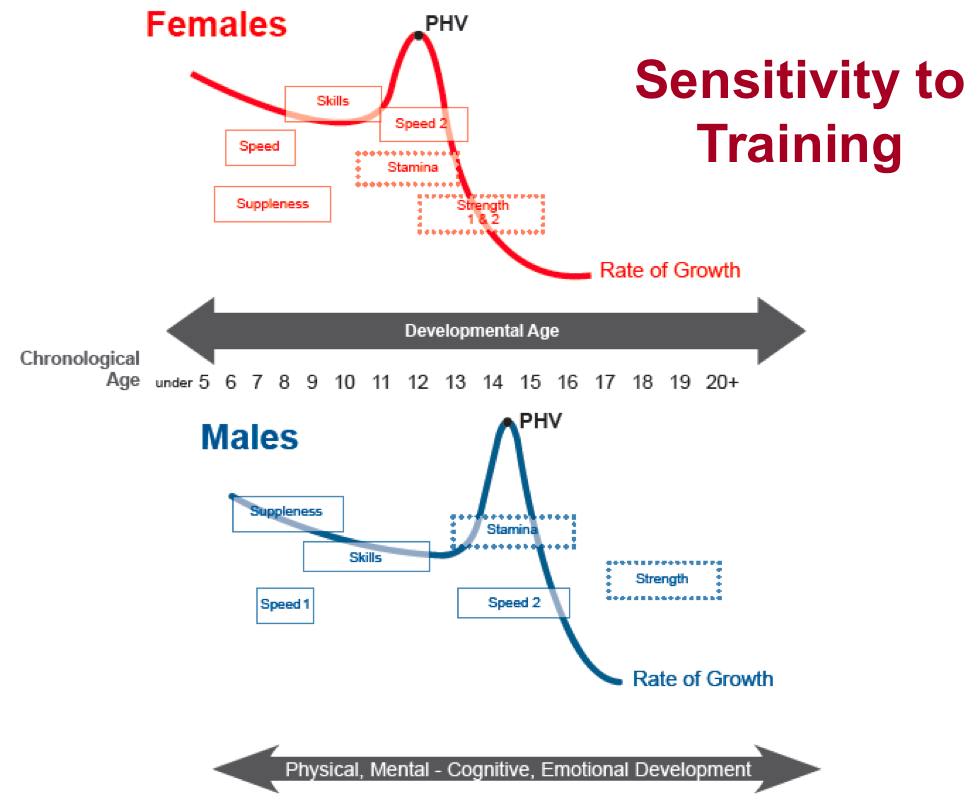
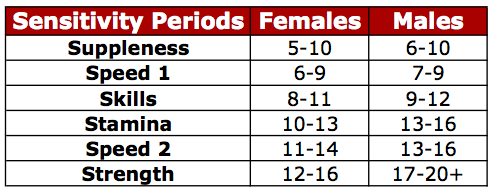
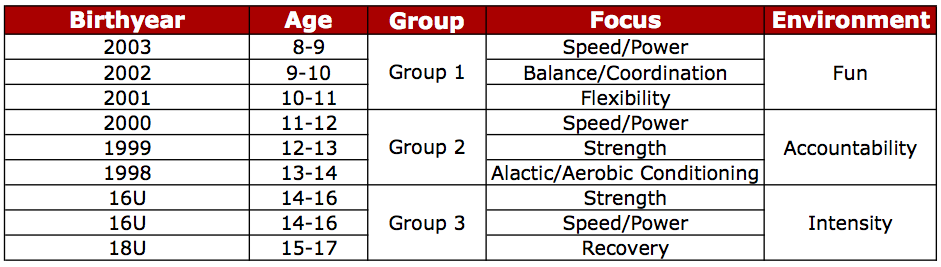
Before writing a program, I first divided the organization up into three groups based on their age and where they fall in the long-term athletic development scheme that USA Hockey has done such a great job outlining for hockey players.

From here, I was able to superimpose this model onto the teams that Comcast has, and determine what the primary focus of each training group should be. It’s important to keep in mind at this point that “training focus” in this regard INCLUDES on-ice work, which we aren’t able to control. I’ve talked a lot about this in the past, but most relevant to this discussion, despite “speed” being a top priority for Group 2 (see below), we don’t program any off-ice speed work for this group as almost everything they do on the ice is speed oriented. Instead, we program complimentary qualities off the ice that will allow them to express their full speed potential on the ice, without overstressing the hip flexors and adductors, which are two of the more commonly injured muscle groups in hockey players (as you know).

The next step in this process was to lay out the number of weeks in a typical season (factoring in breaks for holidays), and then determine how I want to alter stresses across that time span.

These models simply put a more targeted focus on various time periods throughout the season without losing the focus of the long-term athletic development models presented above. Notably absent is a “Group A” periodization model. As I alluded to above, younger kids have a larger capacity to adapt to new stressors and, in general, don’t accumulate fatigue like older players do. All this means is that most of our progressions are in exercise or activity complexity, not necessarily in physiological specificity. As a result, it wasn’t necessarily to segregate a separate training model for that group, only to determine what a typical workout would look like, and progress accordingly.

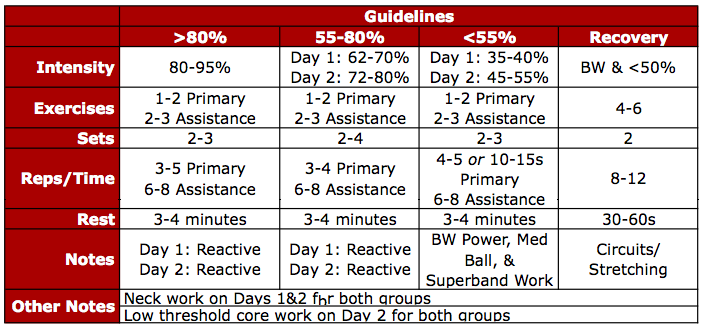
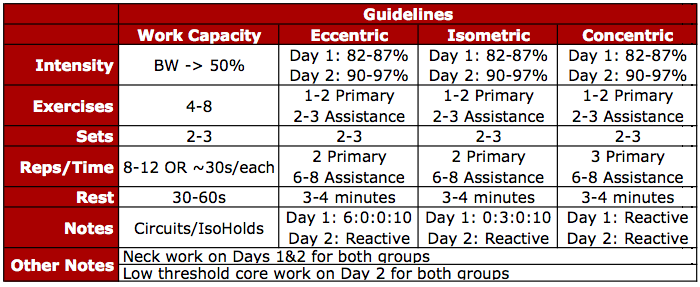
Finally, the last step of the planning process before actually writing the programs is to outline the guidelines for each of the phases above.

This may seem like a lot of work, but it’s really not. You create the model once and you can use it for as long as it’s effective or until you learn something new that you think warrants changing. Following this process at the beginning of each season makes writing the actual programs extremely easy. It’s just a matter of determining how to most effectively teach and progress exercises to a large group and then plugging in the information from the tables above.

To your success,

Kevin Neeld

P.S. If want to ensure you’re choosing the right exercise strategies for your team, check out Ultimate Hockey Training, which outlines the exact exercise progressions and regressions to use for every major movement pattern, including multi-directional core training!


Please enter your first name and email below to sign up for my FREE Athletic Development and Hockey Training Newsletter!
A couple days ago I posted the presentation (with the videos) I gave at the USA Hockey Level 4 Coaching Clinic in NJ. If you missed it, check it out here: USA Hockey Level 4 Presentation

After the talk, I got a great question from one of the coaches in attendance. To paraphrase, he wanted to know what the ideal pre- and post-game meals or supplements were to help prepare for and recovery from optimal performance. I love this question. It demonstrates an understanding of the impact that food/fuel can have on an athlete’s performance/recovery. Naturally, as the players achieve higher and higher levels of performance, their approach to training, nutrition, and recovery will need to be tweaked to squeak out as much potential as possible.

That said, in every performance category it’s important to understand the perspective of where the player is starting. It is very common for folks to be attracted to the strategies used by the elite, but when a player has a large adaptation window (or huge room for improvement) then the strategies they use should be simple. There are tons of applications of this concept, but relevant to this coach’s question, the best thing a hockey player could do to improve their performance (and overall health, durability, immune system resiliency, etc.) is to start eating REAL food (food that can be hunted or grown). We’re talking about a population that eats almost entirely processed foods, largely grain- or high fructose corn syrup based. There is a HUGE window for drastic improvement simply by changing to higher quality nutrient choices throughout the day. Throw out the snacks and start eating actual food, not food products.

I’ve been a big supplement guy in the past, and I’m not opposed to them now, but giving a 14 year old that eats garbage all day a Muscle Milk after their workout sends the wrong message. I think we need to make a bigger push toward holistic eating in our youth. Food is incredibly powerful, much more so than people recognize.

And kids may be smarter than we give them credit for.

I say all that to say this: The message that needs to be sent is that “pre-game” preparedness is a year-round endeavor. You can’t eat garbage all week or all day and then eat grilled chicken, quinoa, and steamed broccoli and expect to overcome all the prior poor decisions. With that said, if framing this message in a “these are the best foods to eat before and after practices and games” gets kids to eat two meals a day of higher quality foods, then it’s worthwhile. This can then be used as a springboard for adapting other dietary habits.

To provide some applicability to this post, I generally recommend players eat a meal pre- and post-game that consists of a plate divided up into thirds with a lean meat (e.g. chicken, turkey, ham, and eggs), vegetable (e.g. broccoli, spinach, peppers, asparagus, and carrots), and quality grain source (e.g. quinoa, sweet potato, and gluten-free pasta or rice). This gives the players the freedom to choose foods that they enjoy. If a meal can’t be consumed within an hour or so following getting off the ice, players would do well to grab a chocolate milk ASAP after getting off the ice. I still don’t think kids should drink Gatorade; if there is a push for a sports drink then they’d be better off with Generation UCAN.

If you’re looking for other great food choices, check out this “high performance” grocery list. I also highly recommend you pick up a copy of Ultimate Hockey Nutrition, which is the single-best Hockey Nutrition resource I’ve ever come across. It was written as a companion resource to my book Ultimate Hockey Training, but if you want to dive into the nutrition stuff first, you can pick up a copy of UHN by clicking the link below.

Grab your copy here >> Ultimate Hockey Nutrition
To your success,

Kevin Neeld

Please enter your first name and email below to sign up for my FREE Athletic Development and Hockey Training Newsletter!

On Saturday I had an opportunity to present at the USA Hockey Level 4 Coaches Clinic in New Jersey. I was fortunate to sit in on the presentations from John Riley, Kerry Fraser, and Ryan Walter, all of which were insightful and inspiring. It makes me miss being on the ice!

As is often the case during events like this, the schedule was changed a bit and I had about 40 minutes to get through 60 minutes of material. While I was able to get through most of it, I did have to skim over some of the slides and skip over a few videos, a couple of which I think are extremely beneficial for coaches to see (e.g. the dynamic warm-up and lateral miniband walk videos). As a result, I wanted to post a copy of the power point (in PDF format), and the videos to the presentation below, so anyone in attendance that’s interested has an opportunity to review the material and post any questions they may have below.

Also, I know there was a lot of interest in where to buy some of the basic equipment I reference in the presentation (i.e. foam rollers and minibands). You can buy some of this stuff at any sporting goods store, but I’ve found the quality is pretty poor. The only company we use is Perform Better. Their stuff is high quality, inexpensive, and they have the best customer service out there. For your convenience, you can access the foam rollers (get 1′ 6″ round rollers for your whole team), and minibands (I recommend the yellow ones for younger teams, and green and blue for peewees and above) here: Foam Rollers, MiniBands.

I’ll be posting Q&As and a couple points of clarification on important training methods and their application to hockey performance throughout the week, so please post any questions/comments you have below.

You can download the presentation here: Physical Development for the Hockey Athlete

Videos are below. I also included a few that were in the talk I gave at the USA Hockey U-14 Regional Camp in Colorado Springs earlier in the Summer.

Enjoy.

Foam Roll Circuit

Dynamic Warm-Up

Quick Feet

Front 1/2 Kneeling Start

Side 1/2 Kneeling Start

Lateral Back Pedal to Sprint

5-Yard Sprint to 5-Yard Backward Back Pedal to 10-Yard Sprint

Lateral Bound

Hang Clean

Med Ball Shotput w/ Rapid Step Behind and Partner Toss

DB Reverse Lunge

Reverse Lunge (Front Squat Grip)

DB 1-Leg Stiff-Legged Deadlift

DB Chest Press

1-Arm DB Row

Wall March Hold

Lateral MiniBand Walk

Split Squat IsoHold to Slideboard

To your success,

Kevin Neeld

P.S. Get an inside look at how I design year-round comprehensive hockey training programs here: Ultimate Hockey Training

Please enter your first name and email below to sign up for my FREE Athletic Development and Hockey Training Newsletter!

On Monday I flew to Minneapolis to work at USA Hockey’s Women’s National Team Camp. The camp boasts the top 28 U-18 girls, and top 51 O-18 players in the country and provides a great opportunity to check with everyone to assess their progress both on and off the ice. It’s been a great experience so far, and as always, I’ve been learning a lot about what it takes to develop a world-leading program.

As you can imagine, orchestrating on- and off-ice testing for 79 girls and processing the subsequent data has occupied a significant amount of time over the last 4 days. As a result, I haven’t had as much time to read or write as I typically do. I did, however, come across a great article from Andreas Wochtl, who coaches a few hours away from where our facility is. Andreas and I actually grew up playing in the same organization, but missed playing with each other by a year. As a European, I’ve been really interested to hear his thoughts on the current state of youth hockey development and learn about how he runs his programs. On that note, I want to share his article “Thoughts on the American Development Model” with you. Hopefully this stimulates some thought and discussion in the comments section below.

Thoughts on the American Development Model
I wanted to take a moment and bring USA Hockey’s ADM program to everyone’s attention.  I’m sure you all have heard mention of this program (our team is now ADM compliant etc).  This program is very extensive and detailed and there are tons of lists of factors and other implementation strategies (read sleeping pills).  I can’t claim that I’m an expert on the ins and outs of this model but I’d like to share a few highlights that I think are important and worth sharing.

This is a long-term athlete development model that was introduced by USAH a few years ago (2009 if you’re curious) essentially to grow the sport of hockey and introduce it to more and more players.  This was not done overnight nor on a whim; they spent years gathering data and talking to the leaders worldwide within the sport of hockey.  The idea was to shift the focus away from games & results. This incorrect focus led to a large numbers (more than half) of players quitting before Peewee’s and one in five players quit after their first year.   USAH wants youth teams to spend more time on the practice and effort.  The program is supported by virtually every coach from the junior/college levels and up.

The key difference and the key for the success of growing the sport of hockey is positive reinforcement and allowing players to learn, fail, and ultimately succeed.  Spending LESS time playing games, traveling to games, preparing for games, worrying about the scores of games, worrying about how much ice time I will get in games….you get the idea.  USA Hockey wants all players to have an opportunity to learn to love the game of ice hockey, not be discouraged before they even get familiar with it.  Why would anyone, adult or child, want to keep playing a sport in which the coach tells you you aren’t good enough, directly or indirectly, and you don’t get the same opportunity to participate games and practice?  I bet a lot of guys (and girls) playing in adult leagues wouldn’t be very happy if there was a coach behind the bench doing these very same things when all you want to do is go out there and have fun.

If not wasn’t enough, games are not the best place for skill development….practice is.  The best Peewee aged players touches the puck for 38 seconds per game (according to a puck possession study done by USAH) if I told parents that their son/daughter will only touch a puck for 38 seconds during an entire practice you would tell me I’m crazy.  How can you get good at anything in 38 seconds?  The answer of course is you can’t, you need time and you need repetition which you can only get in practice.  Even further, NCAA college teams or the best prep schools in the country play nearly as many games as some of the mite teams in this area.  Why?  They know it’s in their players best interest to practice to help their players get onto the next level.

Some will argue that this is taking away from the “stronger” players at the younger levels who are so far ahead of their peers, or that it doesn’t allow the kids to compete fully.  To put it bluntly, that is the biggest crock of you-know-what I’ve ever heard.  When I hear, “oh he/she is the best player in the area”, although that’s great and yes that player should be proud of his accomplishments so far, there is a 60% chance that player will quit by the time he’s a Peewee or older.  The ADM model allows the players who have the potential to be truly “better” to develop and emerge over time rather than have players to “peak out” at 11-12.  Also, it still DOES encourage competition and not what I call “everyone-gets-a-trophy”.

Attitude.  Competition is part of any sport, but it must be healthy competition not irate and, at times, shall we say ethically questionable.

The biggest obstacle to successfully implementing this program are adults.   We are the biggest problem, yet we are the ones in charge of making it happen.  Too many times have I heard/seen/experiences coaches who focus on their own short-term goals, such as shortening the bench in a Squirt game to get the W, or screaming at a player for making a bad play, convincing themselves that the kids really care if they win that tournament and get a trophy, etc etc (you know what I’m talking about) instead of really truly having the best interest of the kids in mind.  We spend energy to plan tournaments, games, and develop the most advanced practices when all we really need to do is throw a puck out there and let the kids do the rest.  A study was completed by Michigan State among 10,000 middle school and high school students to list the top 12 reasons why they play a sport; #1 for both boys and girls was to have fun.  Winning ranked as number #8 for boys and dead last #12 for girls.  There were at least 7 other reasons besides winning that were more important.  The same institute also surveyed why kids stop playing, reason #2 –> they weren’t having fun.

This is a lot of information to comprehend and digest.  The biggest takeaway is to allow our kids to have fun, truly enjoy the sport, and not try to implement adult values on kids sports.  There’s plenty of reading material out there, research papers, and other information that supports these thoughts and that you’re can Google on a late night if you’re out of sheep to count.  I have yet to come across one article supporting a 70-80 game schedule, or even 40 games, at the Peewee level but in all honesty and without sarcasm I would love to see one that did.  As I said earlier, I am not an expert on this ADM stuff nor do I have a formal education in coaching or psychology, which is why I need to spend the time to learn what is out there and what are the best ways to help young players develop.  Please feel free to share your thoughts on this subject and thank you for taking the time to read this note.

To your success,

Kevin Neeld

P.S. A significant piece of the new player development recommendations revolves around following a quality hockey training program!

Please enter your first name and email below to sign up for my FREE Athletic Development and Hockey Training Newsletter!
Use CODE: "Neeld15" to save 15%