As I promised last week, we’ve gotten the new “youth hockey training program” addition of Hockey Strength and Conditioning underway by adding a team dynamic warm-up that players can use before every practice, off-ice training session, and game. Each exercise specifies the exact distance or repetitions to use and has a video. I thought adding a dynamic warm-up was the best place to start as this is something that EVERY player and team can implement immediately.

With warm-ups, consistency is key. The more players can internalize the process, the more it becomes part of their regular routine. This provides them an opportunity to go through something that is physically beneficial before games, but also allows them a time to mentally prepare for the game. Routines are great in this regard.

Get the warm-up here >> Team Dynamic Warm-Up

San Jose Sharks Strength and Conditioning Coach Mike Potenza added an interesting piece on post-game conditioning options. There is some room for debate regarding to what degree players should be conditioning in-season. This really depends on the player’s situation-number of ice slots per week, tempo of practices, playing time in games, and at the youth level-whether they’re playing other sports or not. Naturally, total stress to the body needs to be accounted for. The advantage of using a post-game conditioning strategy is that the team is already together and in “performance mode.” By clumping activity together during one time period of the day, you can maximize the recovery time throughout the rest of the day (at least, as much is possible in the professional setting). The thing I like about Potenza’s article is that he breaks down the conditioning protocols based upon the number of minutes his players play in a game. In this way, the conditioning is specific to the needs of the player and not just a one size fits all approach.

Check it out here >> Post-Game Conditioning

Lastly, my article “Dissecting the 1-Leg Squat” went up this week. The article outlines why I’ve completely abandoned the “pistol” variation of 1-leg squatting, how we lead up to 1-leg squats, and how we progress them. In my opinion, this version of the 1-leg squat is easier to perform, maintains a more optimal alignment of the involved segments and is easier to progress. The article spawned a forum rant about whether the traditional “thigh parallel” identifier of full squat depth is what we should be using.

Get the article here >> Dissecting the 1-Leg Squat

If you aren’t a member, go check out what you’ve been missing by clicking the link below. If you are a member, go check out all the content I mentioned above and hop on the forums to comment on the threads!

Click Here for the best in Hockey Strength and Conditioning

To your continued success,

Kevin Neeld

P.S. Remember, it’s only $1 to try HockeyStrengthandConditioning.com for the first week. You will never find more hockey training content anywhere for $1, and it’s only getting better.

Please enter your first name and email below to sign up for my FREE Athletic Development and Hockey Training Newsletter!

Before we jump into what’s been going on at Hockey Strength and Conditioning, I just wanted to remind you to check out my last post for some great gift ideas for the hockey enthusiasts in your life: Hockey Development Present Ideas

Sean Skahan got things rolling this week with a sample program he used to help a player come back from a low back injury. As I’ve mentioned in the past, I’m always interested in the way other successful coaches write programs because it provides incredible insight into their overall training philosophies. Sean did a good job of providing a few “qualifiers” to his program in the text. In the internet age where people are critiquing programs without a clue of the context in which they’re delivered, I think the extra information is beneficial in that it gives you a bit of background information on what led up to it. You can check out his article here:

Click Here >> Lower Back Reconditioning Phase 5 from Sean Skahan

I also added an article/video combo. A trend that I’m commonly seeing in our baseball and hockey players at Endeavor is that many players have a difficult time retracting and depressing their scapulae (shoulder blades) during pulling movements. Even more disconcerting is when these athletes fail to maintain this scapular position during pressing movements. The video in the article is an excerpt from one of our Endeavor staff meetings where I walk our staff through what the possible causes of this are and what can be to alleviate it. The article adds some valuable information as to the implications of this movement dysfunction and how to “prescribe” and monitor a stretching protocol. Check it out at the link below:

Click Here >> Preventing Shoulder Injuries II: Pec Minor Assessment and Stretching from me

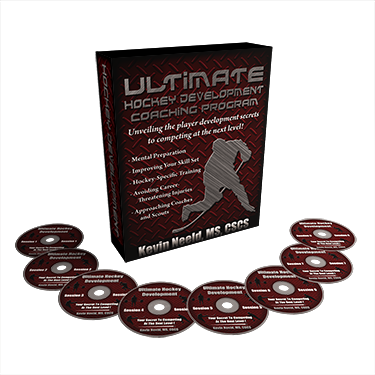
On Wednesday I mentioned that I’d hook you up with a copy of my Ultimate Hockey Development Coaching Program if you signed up for a 1-year membership to Hockey Strength and Conditioning. In keeping with the holiday spirit, I’ll extend that offer through the new year. A membership to Hockey Strength and Conditioning is an incredible value in itself, but I always like getting free stuff (I assume you do too?).

You can listen to the 14 Coaching Calls with some of the hockey development industry’s top experts on your drive in and out of work or while you shovel! Just send me an email after you’ve registered with your name and login id and I’ll shoot you over a download link after I confirm.

Click the link below for more information about Hockey Strength and Conditioning! See you on the inside!

To your continued success,

Kevin Neeld

P.S. Remember, it’s only $1 to try for the first week. You will never find more hockey training content anywhere for $1…trust me (I’ve looked!).

Please enter your first name and email below to sign up for my FREE hockey training newsletter!

Before jumping into today’s post, I just wanted to say a quick congratulations to several of our athletes from this off-season.

  • John Gaudreau (’93) is tied for 2nd on his team (Dubuque Fighting Saints) and tied for 3rd in the USHL for points, as a first year player!
  • Matt DiGirolamo was awarded the starting goalie position at UNH this year and is off to a great start. Check out this article: New Hampshire’s DiGirolamo a blast from the past for Umile
  • Colby Cohen played his first few games in the NHL over the last week and played quite well. Colby worked extremely hard with us at Endeavor all Summer. The gains he made are clearly helping him on the ice.
  • Eric Tangradi scored his first NHL goal a couple weeks back and looks bigger and faster on the ice than ever. great on the ice.

We’re really proud of the hard work these players have put in with us at Endeavor and also on the ice with their respective teams. Keep up the great work guys!

As you may know, I’ve spent a lot of time researching topics related to hip and lower abdominal injuries. Because injuries like hip flexor strains, groin strains, hip labral tears, and sports hernias are affecting an increasing number of players (and receiving an increasing amount of attention), I feel it’s important to do whatever I can do prevent these injuries in our players. Over the last couple years at Endeavor, we’ve pretty much eliminated hip flexor injuries altogether, and have been able to quickly restore balance in players suffering groin strains (almost always in players that refuse to take any time off the ice).

Sports hernias and labral tears can be a bit of a different scenario because surgery is an option, and one heavily pushed by most docs. This raises the debate, “Should ‘strength coaches’ be involved in these types of injuries at all or strictly leave them to surgeons/PTs?” It’s an interesting debate, but one we’ll leave for a different discussion. Over the Summer, we had a player come to us with the following situation:

  • LONG-term adductor/groin pain (several years!), in the area of the adductor longus (as expected)
  • Showed other symptoms of a sports hernia (notably painful during movements that stretch the rectus abdominis)
  • Painful during ALL movements, even jogging
  • No health insurance
  • 5 weeks to train


Goal # 1: Do everything you can to avoid this!

The reason I said we’ll leave the surgery debate for another time is because, without insurance (or shelling out $10,000 in cash), surgery wasn’t an option at all. Nor was seeing a physical therapist for that matter. Admittedly, the situationw as a little intimidating. He had 5 weeks to be symptom free AND to be ready to step on the ice for a new professional team in London, England. With that time course, there is no room for “I think this should work”; you get one shot. I spent quite a bit of time writing his program, and reached out to three incredibly bright coaches/mentors of mine: Eric Cressey, Michael Boyle, and Charlie Weingroff, all of whom provided invaluable insight into the situation.

A couple take homes were:

  • Don’t do ANYTHING that was painful (even mildly painful). In this situation, this meant NO lateral movement (including lateral squats, shuffling, slideboarding, amongst others), no reverse lunges or back leg raised split squats, and no skating!.
  • Focus on restoring balance across the hips. In this situation, this meant restoring length across the anterior hip, loosening up the glutes, and focusing most of the strength work on the posterior chain.

Compared to other off-season hockey training programs, this didn’t leave us with a ton of options. Naturally, we HAMMERED the soft-tissue work for the anterior and interior thigh compartments and also the glutes. We quickly progressed him from a foam roller to a PVC pipe, which gets a bit deeper because of it is so much denser.
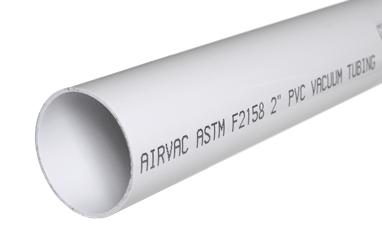

PVC Pipe: An injured hockey player’s best friend.

The two areas I wanted to dive a bit deeper into are the stretching (geared towards adding length to the muscle) and the conditioning.

Stretching: Adding Sarcomeres in Series

Because one of the major focuses was to restore alignment, we used several stretches repeatedly:

  1. 1/2 Kneeling Hip Flexor Stretch w/ Downward Foot Press
  2. 2-Way Rectus Femoris Stretch w/ Downward Foot Press
  3. Stability Ball Internal Rotation Stretch
  4. Prone Active Hip Internal Rotation Holds
  5. Seated Glute Stretch
  6. Med Ball Loaded “Y” Stretch

Again, the goal here was to open up the anterior hip (remove some of the anterior tilt), improve hip internal rotation, and increase his ability to extend through the thoracic spine. The “Downward Foot Press” is a strategy we used to increase the tension in the stretched muscle in order to stimulate adding actual length (sarcomeres in series) to the muscle. We also had him hold the 1/2 Kneeling Hip Flexor Stretch for 5 mins on each side for the same reason. Stimulating actual muscle length is achieved through prolonged time in a stretched state and/or tension in a stretched state. After several weeks of this, he said his helps felt a lot looser, and his groin pain was starting to subside a bit.

Conditioning: How to stay in good shape when every movement hurts

How do you condition a hockey player when he can’t skate, run or slideboard, and you don’t want him to bike because of the concern of further exacerbating his already substantially shortened hip flexors? There are a couple options left, but the two that suited our purposes the best were:

  1. Forward Sled Marches
  2. Med Ball Circuits

On our sticky track, it typically takes around 25-30s to march a sled 25-yards to the end of the track. This made it pretty easy to build in an interval training component to his program. Because his body orientation while marching with the sled didn’t necessitate extreme hip flexion, he was able to perform the exercise pain free. Two wins.

Med Ball Circuits were a no brainer. High intensity, maximum velocity rotational movements are a must for off-season hockey training programs anyway. Devising a circuit to incorporate these was another great way to get some extra valuable work in while also improving his conditioning. The circuit was:

  1. Overhead Med Ball Slams: 12x
  2. Front Standing Med Ball Scoops: 10x/side
  3. Side Standing Med Ball Shot Put: 10x/side
  4. Underhand Med Ball Scoops: 12x

We’d have him perform the circuit anywhere from 3-5x, depending on the week.

At this point, you’re probably wondering what the outcome of all this was. After all, understanding these strategies is only worth your time if they worked. Last week he sent me a quick message to update me on how things are going. He said he’s been completely pain free all season (first time in years!), and he’s currently the second leading scorer on the Newcastle Vipers (EIHL).

A few important take homes from this experience:

  1. Many injuries that are typically thought to warrant surgery can be treated conservatively if done right
  2. A crucial factor in alleviating “soft-tissue” injuries is to avoid anything that irritates it
  3. EVERY PLAYER NEEDS TO TAKE TIME AWAY FROM THE ICE EVERY YEAR!
  4. Having a network of experienced professionals in your field is invaluable
  5. Studying injury risk factors can have a profound impact on your athlete’s careers. It’s worth your time.

To your success,

Kevin Neeld

Please enter your first name and email below to sign up for my FREE Athletic Development and Hockey Training Newsletter!

Some great new additions to Hockey Strength and Conditioning this week from coaches that have a profoundly successful history training pro hockey players:

Video: TRX Lateral Line from Sean Skahan
Coach Skahan presents an interesting core training exercise using the TRX. This was one of those videos that gave me ideas for a half dozen other exercises. Great stuff.

Program: Phase 2 for an NHL or College Player from Michael Boyle
A sample training program for elite level players from a coach that has trained more elite level hockey players than anyone else in the world. Not a bad resource to look at!

Article: VO2 Max Testing from Jaime Rodriguez
Jaime is currently working as the Strength and Conditioning Coach for the Worcester Sharks, the AHL affiliate for San Jose. This is a great article addressing the appropriateness/importance of using VO2 as a quantitative measure for hockey players.

Article: How do you customize or individualize a workout for a hockey player? from Mike Potenza
Coach Potenza outlines how, why and when to customize training programs for specific individuals. This is a great look into his personal coaching philosophy, which has developed from years of education and experience.

If you aren’t a member yet, you’re missing out big time! The forums have been as busy as ever with great content, including a post with heart rate data from an elite level player during a game, and a grad student inquiring about NHL/AHL internships. For less than $10/month, you won’t find more powerful content anywhere.

Click the link below for more information about Hockey Strength and Conditioning!

To your continued success,

Kevin Neeld

Please enter your first name and email below to sign up for my FREE hockey training newsletter!

Another great content week over at Hockey Strength and Conditioning! Check out what you’ve been missing:

Video: Front Split Squat with Chains from Sean Skahan

Great variable loading exercise from Coach Skahan. These exercises are designed to unload the legs/hips during the ranges of motion when that musculature isn’t as strong (or is at a mechanical disadvantage), and overload the legs/hips at the ranges of motion when they’re stronger.

Article: If You Don’t Have Time, Make Time! A Daily Approach to Training the Hip Musculature and Core from Mike Potenza

This isn’t an article as much as it is a program. Coach Potenza outlines four unique core training workouts to target all the musculature around the hips and torso.

Videos: Dryland Skating Exercises, Part 2 from Darryl Nelson

These were cool. Coach Nelson posted these videos in response to a forum thread asking about what strength and conditioning coaches were doing off the ice, if anything, to help improve skating mechanics on the ice. Great stuff here coming from the U.S. National Development Program.

Program: In-Season Hockey Training Program (2x/Week) from me

Endeavor’s 2-day per week in-season hockey training program. As always, everything is laid out here from exercise selection to set and rep schemes.

Article: How to Choose a Personal Trainer/Strength and Conditioning Coach for Your Son and/or Daughter from Sean Skahan

Four great guidelines from Coach Skahan on how to sort through all the “hockey specific training” crap out there and find a quality coach for your son/daughter to work with. As a coach, these are things we should all be familiar with as well.

Click the link below for more information about Hockey Strength and Conditioning!

To your continued success,

Kevin Neeld

Please enter your first name and email below to sign up for my FREE hockey training newsletter!

Use CODE: "Neeld15" to save 15%