
On Monday I flew to Minneapolis to work at USA Hockey’s Women’s National Team Camp. The camp boasts the top 28 U-18 girls, and top 51 O-18 players in the country and provides a great opportunity to check with everyone to assess their progress both on and off the ice. It’s been a great experience so far, and as always, I’ve been learning a lot about what it takes to develop a world-leading program.

As you can imagine, orchestrating on- and off-ice testing for 79 girls and processing the subsequent data has occupied a significant amount of time over the last 4 days. As a result, I haven’t had as much time to read or write as I typically do. I did, however, come across a great article from Andreas Wochtl, who coaches a few hours away from where our facility is. Andreas and I actually grew up playing in the same organization, but missed playing with each other by a year. As a European, I’ve been really interested to hear his thoughts on the current state of youth hockey development and learn about how he runs his programs. On that note, I want to share his article “Thoughts on the American Development Model” with you. Hopefully this stimulates some thought and discussion in the comments section below.

Thoughts on the American Development Model
I wanted to take a moment and bring USA Hockey’s ADM program to everyone’s attention.  I’m sure you all have heard mention of this program (our team is now ADM compliant etc).  This program is very extensive and detailed and there are tons of lists of factors and other implementation strategies (read sleeping pills).  I can’t claim that I’m an expert on the ins and outs of this model but I’d like to share a few highlights that I think are important and worth sharing.

This is a long-term athlete development model that was introduced by USAH a few years ago (2009 if you’re curious) essentially to grow the sport of hockey and introduce it to more and more players.  This was not done overnight nor on a whim; they spent years gathering data and talking to the leaders worldwide within the sport of hockey.  The idea was to shift the focus away from games & results. This incorrect focus led to a large numbers (more than half) of players quitting before Peewee’s and one in five players quit after their first year.   USAH wants youth teams to spend more time on the practice and effort.  The program is supported by virtually every coach from the junior/college levels and up.

The key difference and the key for the success of growing the sport of hockey is positive reinforcement and allowing players to learn, fail, and ultimately succeed.  Spending LESS time playing games, traveling to games, preparing for games, worrying about the scores of games, worrying about how much ice time I will get in games….you get the idea.  USA Hockey wants all players to have an opportunity to learn to love the game of ice hockey, not be discouraged before they even get familiar with it.  Why would anyone, adult or child, want to keep playing a sport in which the coach tells you you aren’t good enough, directly or indirectly, and you don’t get the same opportunity to participate games and practice?  I bet a lot of guys (and girls) playing in adult leagues wouldn’t be very happy if there was a coach behind the bench doing these very same things when all you want to do is go out there and have fun.

If not wasn’t enough, games are not the best place for skill development….practice is.  The best Peewee aged players touches the puck for 38 seconds per game (according to a puck possession study done by USAH) if I told parents that their son/daughter will only touch a puck for 38 seconds during an entire practice you would tell me I’m crazy.  How can you get good at anything in 38 seconds?  The answer of course is you can’t, you need time and you need repetition which you can only get in practice.  Even further, NCAA college teams or the best prep schools in the country play nearly as many games as some of the mite teams in this area.  Why?  They know it’s in their players best interest to practice to help their players get onto the next level.

Some will argue that this is taking away from the “stronger” players at the younger levels who are so far ahead of their peers, or that it doesn’t allow the kids to compete fully.  To put it bluntly, that is the biggest crock of you-know-what I’ve ever heard.  When I hear, “oh he/she is the best player in the area”, although that’s great and yes that player should be proud of his accomplishments so far, there is a 60% chance that player will quit by the time he’s a Peewee or older.  The ADM model allows the players who have the potential to be truly “better” to develop and emerge over time rather than have players to “peak out” at 11-12.  Also, it still DOES encourage competition and not what I call “everyone-gets-a-trophy”.

Attitude.  Competition is part of any sport, but it must be healthy competition not irate and, at times, shall we say ethically questionable.

The biggest obstacle to successfully implementing this program are adults.   We are the biggest problem, yet we are the ones in charge of making it happen.  Too many times have I heard/seen/experiences coaches who focus on their own short-term goals, such as shortening the bench in a Squirt game to get the W, or screaming at a player for making a bad play, convincing themselves that the kids really care if they win that tournament and get a trophy, etc etc (you know what I’m talking about) instead of really truly having the best interest of the kids in mind.  We spend energy to plan tournaments, games, and develop the most advanced practices when all we really need to do is throw a puck out there and let the kids do the rest.  A study was completed by Michigan State among 10,000 middle school and high school students to list the top 12 reasons why they play a sport; #1 for both boys and girls was to have fun.  Winning ranked as number #8 for boys and dead last #12 for girls.  There were at least 7 other reasons besides winning that were more important.  The same institute also surveyed why kids stop playing, reason #2 –> they weren’t having fun.

This is a lot of information to comprehend and digest.  The biggest takeaway is to allow our kids to have fun, truly enjoy the sport, and not try to implement adult values on kids sports.  There’s plenty of reading material out there, research papers, and other information that supports these thoughts and that you’re can Google on a late night if you’re out of sheep to count.  I have yet to come across one article supporting a 70-80 game schedule, or even 40 games, at the Peewee level but in all honesty and without sarcasm I would love to see one that did.  As I said earlier, I am not an expert on this ADM stuff nor do I have a formal education in coaching or psychology, which is why I need to spend the time to learn what is out there and what are the best ways to help young players develop.  Please feel free to share your thoughts on this subject and thank you for taking the time to read this note.

To your success,

Kevin Neeld

P.S. A significant piece of the new player development recommendations revolves around following a quality hockey training program!

Please enter your first name and email below to sign up for my FREE Athletic Development and Hockey Training Newsletter!

At the end of last week I got an email from Cal Dietz, the Strength and Conditioning Coach of the University of Minnesota Men’s and Women’s Ice Hockey Teams (among other sports), with several sample programs that fit within his “Triphasic Training” paradigm. I met Cal in person for the first time at the BSMPG seminar a couple years back. Aside from Cal being a great guy, I enjoy talking shop with him because he has a significantly different approach to how he tackles training program design for his athletes. I’ve learned a great deal from hearing him speak and from the conversations he and I have shared about some of his methods and the rationale for them.

Among other things, Cal taught me that it’s okay to eat raw red meat for breakfast (don’t try this at home)

When he fired over the email with a number of sample programs for an advanced level hockey player, I thought it would be a great idea to share these with you (with this permission of course). As a reminder, it’s generally not appropriate to take a program off the internet and start using it yourself without any context. Instead of taking it for face value and diving in, I’d encourage you to break down the program and see if you can infer Cal’s rationale for structuring things the way he did. In my opinion, once you understand another coach’s rationale and philosophy, it’s infinitely easier to understand how their methods fit into your paradigm appropriately.

Programming for an Advanced Hockey Athlete, 6 week Triphasic Training protocol

All Names Underlined in Blue are hyperlinked in to PDF the names on PDF’s are hyperlinked to video’s.

Click here to learn how to read sheetshttp://www.xlathlete.com/xl/events/Reading%20the%20Training%20Sheet%202012.pdf

In Block one of training The focus is Eccentric strength/withstanding force and Tissue remodeling with the heavy loaded eccentric training for two weeks to cause actin and myosin damage so the immune system cleans it out and then it gets rebuilt stronger.

Block 1 – 2 Weeks  Possible Leg Programs

The leg training for the first two weeks, Block 1 Eccentric Above 80 Triphasic Training Back Squat  is those athletes whose spine and physical fitness levels are acceptable to perform squatting 3 days a week. 95 percent of my athletes fall into this category. the second possible program during this Block is for this athletes that can’t due Spinal loading for any reason, Block 1 Eccentric Above 80 Triphasic Training Single Leg Strength. The third, possible is a little load single leg work, non of my athlete completed this because of the focus of remolding. Block 1 Eccentric below 80 Triphasic Training Single Legs Speed

Block 1 Eccentric above 80 percent, the eccentric focus, is a very intense nature,

Block 1 Eccentric Above 80 Triphasic Training Back Squat

http://www.xlathlete.com/xl/events/Block%201%20Eccentric%20Above%2080%20Triphasic%20Training%20Back%20Squat.pdf

The heavy Squats with 6 second eccentrics have to help

—————————-

Block 1 Eccentric Above 80 Triphasic Training Single Leg Strength

http://www.xlathlete.com/xl/events/Block%201%20Eccentric%20Above%2080%20Triphasic%20Training%20Single%20Leg%20Strength.pdf

———————————-

Block 1 Eccentric below 80 Triphasic Training Single Legs Speed

http://www.xlathlete.com/xl/events/Block%201%20Eccentric%20below%2080%20Triphasic%20Training%20Single%20Legs%20Speed.pdf

—————————–

Block 1 Eccentric Above 80 Triphasic Training upper

http://www.xlathlete.com/xl/events/Block%201%20Eccentric%20Above%2080%20Triphasic%20Training%20upper.pdf

Block 2 – 2 weeks

Block 2 Isometric Above 80 Back Squat

http://www.xlathlete.com/xl/events/Block%202%20Isometric%20Above%2080%20Back%20Squat.pdf

—————————–

Block 2 Isometric Above 80 Single leg Squat

http://www.xlathlete.com/xl/events/Block%202%20Isometric%20Above%2080%20Single%20leg%20Squat.pdf

——————————

Block 2 Isometric Above 80 Upper Body

http://www.xlathlete.com/xl/events/Block%202%20Isometric%20Above%2080%20Upper%20Body.pdf

Block 3 – 2 Weeks

Block 3 concentric Above 80 Back Squat Heavy

http://www.xlathlete.com/xl/events/Block%203%20concentric%20Above%2080%20Back%20Squat%20Heavy.pdf

—————————

Block 3 concentric Above 80 Single Leg Work

http://www.xlathlete.com/xl/events/Block%203%20concentric%20Above%2080%20Single%20Leg%20Work.pdf

—————————–

Block 3 concentric below 80 Single Leg Work

http://www.xlathlete.com/xl/events/Block%203%20concentric%20Above%2080%20Single%20Leg%20Work.pdf

—————————–

Block 3 concentric Above 80 upper body

http://www.xlathlete.com/xl/events/Block%203%20concentric%20Above%2080%20upper%20body.pdf

—————————–

Block 3 concentric below 80 upper body –  http://www.xlathlete.com/xl/events/Block%203%20concentric%20below%2080%20upper%20body.pdf

To your success,

Kevin Neeld

Please enter your first name and email below to sign up for my FREE Athletic Development and Hockey Training Newsletter!
Back on track this week with a wrap-up of this week’s (and the three preceding week’s since I’ve been slacking) activity in the world of hockey strength and conditioning. Over the last several weeks, I’ve added several articles on topics ranging from strength and conditioning internships to specific hockey training techniques to maximize performance and minimize injury risk. Check out what you’ve been missing at the links below.

  1. Strength and Conditioning Internships
  2. The Myth of Wrist Strength in Hockey
  3. Managing Structural and Functional Asymmetries: Part 1
  4. Managing Structural and Functional Asymmetries: Part 2
  5. Improving Athletic Performance Beyond Peak Strength: Part 1
  6. Improving Athletic Performance Beyond Peak Strength: Part 2
  7. Off-Season Hockey Training Program
  8. Men’s Fitness: Hockey Training Feature
  9. What It Means To Be A “Boyle Guy”

We’ve also added a TON of great content over at Hockey Strength and Conditioning. I HIGHLY encourage you to read through all of these pieces as I think there is an awesome combination of quality information, great training programs, and unique exercises that will apply to players at multiple levels. We’ve also had a few terrific contributions from a few guys I hold in a very high regard in Anthony Donskov, Jim Snider, and Kyle Bangen. Check out the links below.

Articles

  1. Debit Card Strength and Conditioning: In-Season Account Withdrawls from Anthony Donskov
  2. Essential Components of a Strength Training Program from Darryl Nelson
  3. Pro’s vs. Joe’s from Jim Snider
  4. Triple Flexion Training Considerations in Hockey from Kyle Bangen

Programs

  1. Spring Training 4-Day Per Week from Darryl Nelson
  2. Summer 2012 GPP Phase 1 from Mike Potenza
  3. 2012 5-Day Off-Season Hockey Training Program: Phase 1 from me
  4. Off-Season 2012 Phase 2 Strength Training from Sean Skahan

Videos

  1. Side Lying 1-Leg Hip Extension from Sean Skahan
  2. 2 Arm DB Snatch from Darryl Nelson
  3. Phase 1 Sprinting Variations from me
  4. Hip Extension Holds from Mike Potenza

That’s a wrap for today. As always, if you aren’t a member yet, I encourage you to try out Hockey Strength and Conditioning for a week. It’ll only cost $1, and if it’s not the best buck you’ve ever spent, I’ll personally refund you!

To your success,

Kevin Neeld

Please enter your first name and email below to sign up for my FREE Athletic Development and Hockey Training Newsletter!
In Part 1 of this “Dissecting Muscle Function” series, I outlined many of the characteristics of muscle that dictates its function. While this was far from a comprehensive look on muscle function, it does illustrate a few of the major concepts that dictate how we produce force, and how these components can be manipulated to improve performance. If you missed it, check it out here: Dissecting Muscle Function: Force Production

In Part 2, I want to demonstrate the vast influence that muscle can have on surrounding structures. Many of these concepts can be described within the paradigm of regional interdependence, which I touched on in a recent post.

Origins and Insertions vs. Attachments
When I first learned about muscle anatomy, it was very simple. Each muscle originated on one bone, inserted on another, and when movement was warranted, the origin stayed fix while the muscle moved the insertion. I’ve come to appreciate that this is a GROSSLY over-simplified view of functional anatomy. In reality, muscles don’t have “origins and insertions” as much as “attachments”. This distinction is important, as it implies that either end of the muscle segment is prone to stability or mobility. Certainly specific joints lend themselves more toward a specific end of that continuum, but there are countless examples of “origins” moving while “insertions” stay still, and excessive motion at joints thought to be stable is a common cause of injury. As a simple example, consider that the biceps bring the forearm to the shoulder in a typical curling movement, but bring the shoulder to the forearms in a chin-up movement. This is the same muscle and same movement (elbow flexion), but with a different point of stability in each exercise.

Functional Anatomy
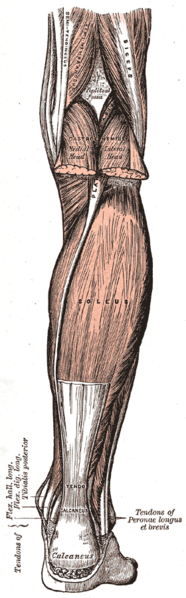
Even in adopting a new appreciation for the appropriateness of using attachments in place of origins and insertions, there is still much more complexity to the muscular system’s influence on movement than is taught in traditional anatomy classes. Muscles almost always have influence in multiple planes, and express different movements depending on whether the movement is open- or closed-chain. For example, most people are familiar with the fact that the soleus, one of the calves, serves a primary role in plantar flexion (pushing up onto your toes). However, when the feet are fixed on the floor, as in a squatting/deadlifting pattern, the calcaneus is relatively fixed, and therefore the soleus will function to pull the tibia posteriorly. Although this is technically plantarflexion, this directly translates into knee extension, and in the presence of a stationary pelvis, hip extension. In this way, the soleus is a knee extensor in closed chain movement, and also influences the hip.

Soleus: Plantarflexor, knee extensor, hip extensor?

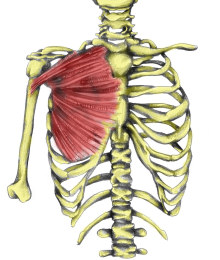
Similarly, muscles play a significant role in joint orientation. While this is somewhat implied by the understanding that muscles move bones, the totality of this relationship is frequently overlooked. For example, fibers of the pectoralis major extend from the sternum, horizontally across the ribs, and insert into the intertubercular groove of the humerus. When describing the function of the pec major, it’s role in glenohumeral flexion, horizontal adduction, and internal rotation is often emphasized. However, the force transmitted to the humerus to produce these motions is dually transmitted to the sternum. The pec major is a major influencer of sternal position (no pun intended), and therefore of the positioning of the opposing pec major. In this way, muscles can influence the positioning and consequent function of bones and muscles.

Note the strong connections of the pec major to the sternum

Interestingly, it is often (but not always) the muscle that is eccentrically loaded that people subjectively feel as tight. In the above example, this would mean that the short or excessively stiff pec major that biases the sternum in one direction may feel relatively normal, whereas the opposite pec major that is under increased tension because of the sternal orientation may feel tight. Stretching, in this case, is not desirable and could even be harmful, as the muscle is already in a lengthened state, and pushing through this could result in compensatory movement of other segments and/or lead to laxity of surrounding tissue.

Postural Restoration Institute
Fortunately, many of these orientations are fairly predictable via the Postural Restoration Institute methodology, which seeks to drive the body toward a more neutral orientation as a means of restoring reciprocal motion between the left and right halves and therefore of improving performance and decreasing injury risk.

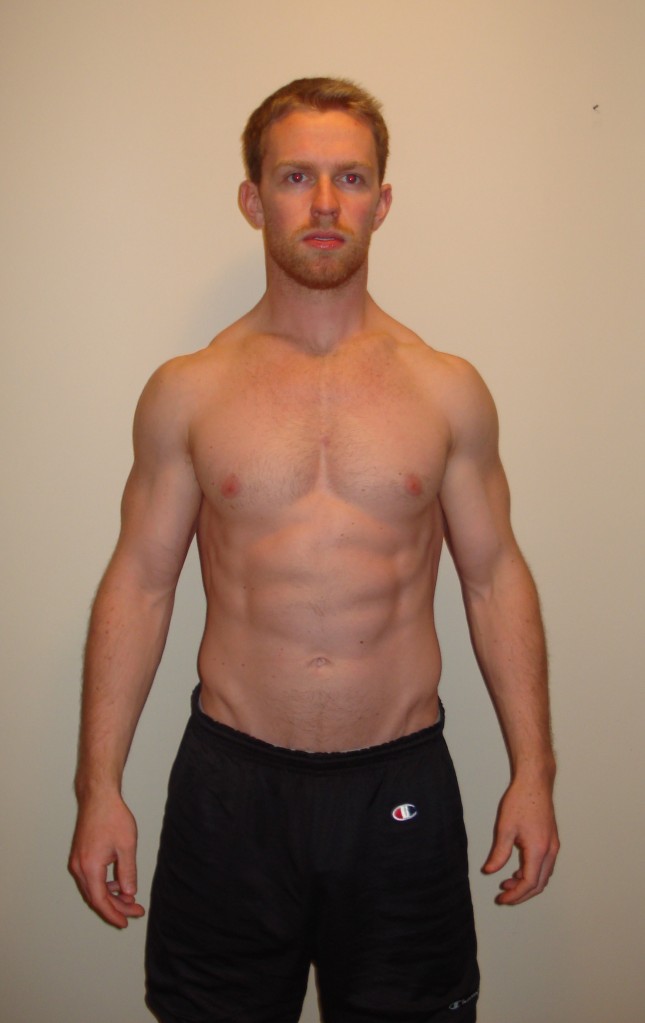
I was able to dig up a picture from a couple years ago that I took as part of a new diet experiment. Check out the picture below and note any side-to-side differences. What do you see?

While some of these things can be difficult to pick up at first if you don’t have a well-trained eye, the fact that my skin is pale to the point of borderline translucency should help. You may notice that my hips are rotated to my right (note the difference in the position and prominence of my obliques), my upper torso is rotated back to the left (note how my right hand is positioned in front of my left hand, and how the left pec major appears to be rotated back and more stretched out), and I’m slightly side-bent to the right (note how my right hand is about an inch lower than my left). You can see that these asymmetries extend up to the orientation of my head (see how much more apparent my right ear is?).

This is a textbook illustration of what PRI would describe as a Left AIC, Right BC position, and, assuming no ligamentous laxity, I would expect to see a decrease in left hip adduction and extension, right glenohumeral internal rotation, and left glenohumeral flexion and horizontal abduction secondary to poor positioning. In other words, it’s not necessarily that short/stiff muscles are limiting the range of motion, it’s simply the position of the underlying skeleton that is positioning the muscles poorly to perform their role. This is evidenced by the fact that in most cases almost complete symmetry can be restored in less than a minute with any number of relatively simple exercises that use active muscle contraction and breathing to re-orient specific bones into a more neutral position. Simply, in one minute, almost full range of motion can be restored. Do you think a baseball pitcher could benefit from 15-20 more degrees of internal rotation on his throwing arm? Can you appreciate how a hockey players stride and crossover ability will be affected by improved hip extension and adduction on the left side?

Wrapping Up
Hopefully you see the importance of understanding the integrated nature of our musculoskeletal/connective tissue and neural systems, and the power in a system that addresses these systems collectively. Relating back to the introductory topic, a muscle’s function is largely dictated by its position, which can be heavily influenced by the role other muscles play in driving and responding to skeletal positioning. The ability to view the body as an integrated system is invaluable, and a failure to do so can have frustrating and even tragic consequences.

To your success,

Kevin Neeld

P.S. Don’t forget, you have only have a few days left to get access to a TON of information to help make you stronger, faster, and get you in drastically better shape for only $1! Click here now >>  Elite Training Mentorship

Please enter your first name and email below to sign up for my FREE Athletic Development and Hockey Training Newsletter!
This week at Hockey Strength and Conditioning was one of those “forum weeks”. Every now and then we intentionally slow down the amount of content we add in the form of articles, programs, videos, etc. so that our members have an opportunity to catch up on some of the stuff we’ve posted over the previous few weeks.

Last week we added Brian Burke’s presentation, which I think echos the hockey development sentiments of the HockeySC team, and (as you know) is one that I think everyone involved in hockey should take an hour to watch. On that note, I understand that some of the Maple Leafs fans out there are reluctant to listen because of a lack of satisfaction with the direction the organization has taken in recent years, but that is not the focus of his presentation-it’s on what changes need to occur in youth hockey to improve the development process. His words are equally applicable to current norms in both the U.S. and Canada!

YOU MUST WATCH THIS!! >> Youth Hockey Presentation

We added a 2 day/week in-season program that I’ve used with our players at Endeavor. In it, you’ll see a new sprint start technique we’ve been experimenting with recently and a new method of conditioning in-season (which we do our best to cycle through to avoid overworking any one pattern).

Check it out here >> In-Season Hockey Training Program

When you sign in, make sure you’re checking in on the forums. The discussions over the last week have been awesome, and Darryl Nelson posted a great video (in the thread “Psychology vs. Physiology) from Dr. Larry Lauer on building/restoring confidence in your team. It’s only five minutes, but there are some important messages in it.

Lastly, my dad emailed this video to me a couple weeks ago and I wanted to share it with you. It’s amazing what people can accomplish when we work together!

[windowsmedia] http://kevinneeld.com/videos/Stick-Figure-Punter.wmv [/windowsmedia]

If the video does not appear above, click this link to watch it >> Stick Figure Punter

I have some great stuff lined up for you for next week so make sure you check back in!

Click Here for the best in Hockey Strength and Conditioning

To your continued success,

Kevin Neeld

P.S. Try HockeyStrengthandConditioning.com for 7 days for only $1! It’ll be the best dollar you’ve ever spent.

Please enter your first name and email below to sign up for my FREE Athletic Development and Hockey Training Newsletter!
Use CODE: "Neeld15" to save 15%