
Over the weekend I posted a video at HockeyStrengthandConditioning.com of a former (and hopefully future) division 1 lacrosse player that I’ve worked with over the last few months at Endeavor Sports Performance. What makes this player unique is that he’s undergone 4 hip surgeries (2 on each side) secondary to femoroacetabular impingement (FAI) and bilateral sports hernia surgery. The video alludes to the importance of recognizing individual limitations and teaching the athlete how to move within his or her own confines.

Working with this athlete also highlights the importance of understanding these so-called abnormalities. When he first came to Endeavor, light jogging wasn’t even an option. In other words, his range of motion was so poor, damage so significant, and overall comfort level with athletic movements so degraded that we really had to start slow. A few months later, he’s sprinting, cutting, and jumping explosively and without pain; he’ll be the first to tell you that he’s never felt better. My ability to effectively work with athletes like this stems directly from the amount of time I’ve spent studying the relevant research. I think this information is valuable for anyone that trains anyone, but if you work with hockey players, it’s absolutely essential. The amount of research in this area has exploded over the last decade; understanding the causes and implications of FAI will help you more effectively train players that present with these injuries (which is most) and help to prevent unnecessary complications.
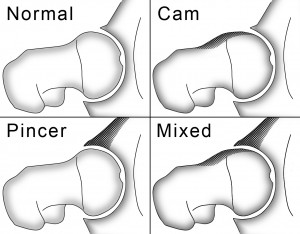
Illustrating “normal” hip joint anatomy and FAI abnormalities

Below is a brief review of some of the current literature:

High prevalence of pelvic and hip magnetic resonance imaging findings in asymptomatic collegiate and professional hockey players

  • MRI findings from 21 professional and 18 NCAA D1 players; all were asymptomatic
  • 14 (39%) dysfunction of adductor-rectus abdominis insertions
  • 25 (64%) hip pathologic changes
  • 30 (77%) have MRI finding of hip or groin pathologic abnormalities

The prevalence of cam-type femoroacetabular deformity in asymptomatic adults

  • Retrospective analysis of CT scans from 419 randomly selected patients from 2004-2009 that were taken for problems unrelated to the hip
  • Of the 215 male hips (108 patients) analyzed, a total of 30 hips (13.95%) were defined as pathological, 32 (14.88%) as borderline and 153 (71.16%) as normal.
  • Of the 540 female hips (272 patients) analyzed, 30 hips (5.56%) defined as pathological, 33 (6.11%) as borderline and 477 (88.33%) as normal.
  • This highlights the prevalence of these injuries in asymptomatic individuals, especially men. This means that, in the general population, roughly 1 in every 3-4 men that you train will have an underlying hip abnormality. The prevalence of these findings in hockey players is drastically higher (see above).

Prevalence of cam-type femoroacetabular impingement morphology in asymptomatic volunteers

  • 200 asymptomatic individuals (111 females, 89 males; average age 29.4 years) had an MRI taken of their hips.
  • 14% of the volunteers had at least one hip with CAM impingement
  • 10.5% had CAM on either the right or the left side; 3.5% had CAM in both hips
  • 22 of 28 individuals (79%) who had CAM were men; only 6 (21%) were women.
  • 22 of 89 (24.7%) men had CAM impingement, compared with only 6 (5.4%) of 111 women.

Hip flexor muscle fatigue in patients with symptomatic femoroacetabular impingement

  • Comparison of hip flexor strength during submaximal isometric and repeated maximal dynamic contractions in those with and without FAI.
  • FAI participants exhibited significant hip flexor weakness compared to the controls
  • No changes were noted in fatigue indices between the two groups
  • Authors noted that those with FAI tend to have adductor and hip flexor weakness. It’s easy to look at these weaknesses and point to them as potential causes of FAI secondary to poor femoral head control. That said, it’s also worth noting that the bony overgrowth limits hip adduction and hip flexion and may cause weakness secondary to neurological inhibition, especially as bony end-range is approached.

Can we predict the natural course of femoroacetabular impingement?

  • Because FAI is so strongly associated with future osteoarthritis, these authors sought to determine whether age of total hip arthroplasty was related to certain radiographic findings and/or activities.
  • Given the complex and dynamic nature of these injuries, it’s not surprising that they weren’t able to find a relationship through their methods. That said, I think they hit the nail on the head with their conclusion: “Hence, considering the high prevalence of FAI-related radiographic findings, we conclude that not every radiographic abnormality requires treatment.”
  • This highlights the importance of not taking every positive radiographic finding and shipping the player off to the surgical table!

Treatment of athletes with symptomatic intra-articular hip pathology and athletic pubalgia/sports hernia: a case series

  • Analyzed 37 hips (average age: 25 years) with BOTH a sports hernia and FAI. Patients were athletes competing at the pro (8), college (15) elite high school (5) and competitive club (9) levels.
  • Evaluation occurred at an average of 29 months post surgery (wide range of 12-78 months though)
  • Of 16 hips that had athletic pubalgia (sports hernia) surgery as the index procedure, 4 (25%) returned to sports without limitations, and 11 (69%) subsequently had hip arthroscopy at a mean of 20 months after pubalgia surgery.
  • Of 8 hips managed initially with hip arthroscopy alone, 4 (50%) returned to sports without limitations, and 3 (43%) had subsequent pubalgia surgery at a mean of 6 months after hip arthroscopy.
  • Thirteen hips had athletic pubalgia surgery and hip arthroscopy at one setting. Concurrent or eventual surgical treatment of both disorders led to improved postoperative outcomes scores (P < .05) and an unrestricted return to sporting activity in 89% of hips (24 of 27).
  • While it’s impossible to make any accurate inferences, I’d be interested to see how these numbers may differ if the athletes were in sport programs with medical professionals that truly understood the implications of the abnormalities and could teach the players how to move within their limits.

In my experience, most players do very well when they understand the limitations in their joint anatomy and are taught how to move within these confines. Because the primary suggested mechanism underlying athletic pubalgia involves a tug of war across the pubic symphysis between the adductors and abdominals AND because those with FAI tend to have very dense/fibrotic adductors, many players will benefit from some soft-tissue work in this region, especially in the area of the proximal adductor magnus attachment. Also, because posterior capsule density can push the femoral head forward in the joint and put excess stress on the anterior/superior labrum, this is another area worth having a manual therapist look at. The manual method itself is less important than the proficiency of the therapist. It can be tough to find someone that is comfortable working in that area, but it is well worth the trouble when you do!

To your success,

Kevin Neeld

P.S. If you’re interested in learning more about hockey hip injuries and associated assessments and corrective strategies, I highly encourage you to check out my presentation “Hockey Hip Assessments: An In-Depth Look at Structural Abnormalities and Common Hip Injuries”, which is now available at Hockey Strength and Conditioning

Please enter your first name and email below to sign up for my FREE Athletic Development and Hockey Training Newsletter!
It’s been a couple weeks (again) since I had an opportunity to write one of these posts. The last few weeks have been pretty crazy in preparing for the release of Ultimate Hockey Training. On top of that, we’re in the process of moving Endeavor to a new location a few miles away from our current one, which I’m really excited about. We’re fortunate to have an opportunity to rebuild our space from scratch a few years in, so we can make adjustments based on some of the frustrations we’ve had in the current space.

On Wednesday I had an opportunity to head up to Quinnipiac University in Hamden, CT to help Coach Boyle and Dawn Strout with another round of testing for the U.S. Women’s National Program. I’ve really enjoyed my work with the program. The girls all work their assess of, and are constantly pushing each other. Great team atmosphere. It was also nice to catch up with Brijesh, who I haven’t seen in too long. That night I drove home from Connecticut packed a bag, woke up the next morning, and got on a plane to Phoenix. I’m in Phoenix for PRI’s Impingement and Instabilities course, which rain prevented me from attending with Cressey in Maine a couple months back. No complaints about being “forced” to coming to Phoenix though! I spent most of the day yesterday with Patrick Ward talking about the nervous system (this is what most cool people do when they get together). Patrick is ridiculously bright and has a different background than I do, so it’s awesome to hear his perspective on things. If you’re not familiar with his work, check out his site (and an article he wrote on my new book) here: Show & Go and Ultimate Hockey Training

This week I wrote two posts that touch on elite hockey development. If you haven’t read them already, you can check them out here:

  1. What if Talent Doesn’t Exist?
  2. What Would You Do to Succeed?

Over the last several weeks, we’ve added A LOT of terrific content to Hockey Strength and Conditioning. Check out what you’ve missed:

New Articles

Why Shoes Make Normal Gait Impossible from Dr. William Rossi

Five Exercises That Hockey Players Should Be Doing in the Weight Room from Sean Skahan

Toronto Maple Leafs 1962 Training Camp

Youth Hockey Training Blueprint: Part 1 from me

The Case for Direct Cuff Training in Contact Sports from Anthony Donskov

Managing Injuries through Manual Therapies from Eric Reneghan

This is an almost overwhelming collection of articles. The Maple Leafs Training Camp article is more for fun than anything else. We’ve certainly come a long way since those days. My article on youth hockey training is the first in a 3-part series that will walk you through exactly how I put together the off-ice training program for a youth hockey organization that we work with. This series will answer most of the questions I get regarding what I recommend for training youth players at different age levels at the rink and identify how I’ve addressed some of the challenges inherent in the space we’re allotted there. Keep your eye out for the other two parts. Dr. Rossi’s shoe article was outstanding. I think the impact of footwear is overlooked by the majority of youth athletes (and their parents) because the assumption is that they wouldn’t sell shoes if they were detrimental to your health. Dr. Rossi’s article systematically explains the impact different shoes have on your structure and performance. Great read.

Training Programs

Off-Season 2011 Phase 2 Strength Training from Sean Skahan

Quarter Sprints from Darryl Nelson

Strength Training for a Hockey Player with a Unilateral Lower Body Injury from Mike Potenza

Three great programs from three great coaches. I think it’s especially important to read through Potenza’s program because of the message it sends. Unilateral injuries are NOT an excuse to stop training! Most players get hurt, go to the doctor, are told the injury will take 6-8 weeks to heal and assume that means they’ll be ready to play in 6-8 weeks. In reality, in 6-8 weeks they have a almost completely healed segment within a drastically deconditioned body. There are RARELY injuries that warrant a complete shutdown (concussions, and recent disc herniations and hernia surgeries are amongst the few). Players can continue to make progress by intelligently training the healthy segments, which will facilitate a faster recovery, return to play, and ensure continued progress despite an injury. Sean’s program series on training an athlete with an ACL tear are great examples of this too so check them out if you haven’t already.

Exercise Videos

Farmer Carry Lateral Squats from Darryl Nelson

Frontal Plane Core Exercises from Mike Potenza

Reach, Roll, and Lift from me

Half Get-Up with Cup of Water from Sean Skahan

Darryl’s video will really appeal to hockey players because it is a relatively hockey-specific movement. We don’t typically load these movements very heavy, but we do use them to groove the pattern and improve hip mobility. Potenza had some creative core exercises in his video montage. The Reach, Roll, and Lift is a lower trapezius activation exercise that has really humbled a lot of our youth players. It’s easy to cheat your way through this one, but when done correctly, it will surprise you how difficult this is. In my opinion, an inability to perform this exercise disqualifies you from overhead lifts. Sean’s video provides another great example of how to continue to groove important patterns, even when an athlete has suffered an injury.

Hockey Assessment Webinar

Hockey Hip Assessments from me

This was a webinar I did a couple months back detailing all of the hip assessments I used with our off-season hockey group at Endeavor, how to interpret the results, and how to use this information to improve the durability of your players. I’m pretty proud of this one as I think it provides strength and conditioning professionals as well as rehab folks with some important tools to recognize structural “abnormalities” that may predispose players to predictable injuries.

Lastly, the forum has been hopping recently. While there are several interesting discussions, I’d recommend checking out the “Post-Game Flush”, “Neck Strengthening”, “Motion Analysis for $5”, “Barefoot Training”, “Diet Programs that Reduce Inflammation”, and “Reactions to LTAD” threads first.

As always, if you aren’t a member yet, I encourage you to try out Hockey Strength and Conditioning for a week. It’ll only cost $1, and if it’s not the best buck you’ve ever spent, I’ll personally refund you!

To your success,

Kevin Neeld

Please enter your first name and email below to sign up for my FREE Athletic Development and Hockey Training Newsletter!
Over the last several weeks, I’ve been very fortunate to have an opportunity to work in close conjunction with Ned Lenny, a really bright physical therapist with an office in Cherry Hill, NJ.  Ned has been doing some in-house work for us at Endeavor, which has been a great educational experience for me and our athletes.

Ned and I were talking about one of our hockey players, and we started talking about training strategies for muscles primarily considered stabilizers. The rotator cuff and the lateral hip musculature are two popular muscle groups that populate the stabilizer category.

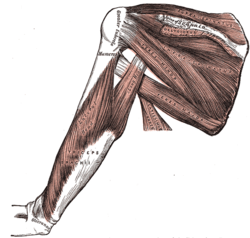
Collectively, the rotator cuff muscles function to stabilize the humeral head within the glenohumeral joint and ensure proper tracking of these two bones on one another

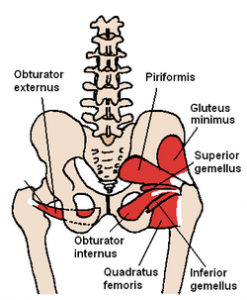
The deep hip rotators (pictured) and the gluteus medius (not pictured) compromise the lateral hip musculature typically considered as serving a stabilization function

These muscle groups do in fact function primarily as stabilizers. In other words, they provide dynamic control of the surrounding joint and stability of the joint so that high levels of force can be generated by the extremities. At the risk of beating this analogy to death, attempting to express strength or power with poor stabilizer function is similar to attempting to shoot a cannon from a canoe. Stability creates the foundation for strength and power. In fact, it’s a prerequisite for the expression of these qualities.

This understanding is a huge step in the right direction from the textbook approach to training where external rotators are only trained in external rotation movements and internal rotators are only training in internal rotation movements without any focus on their co-contraction functions in the interest of more global movement. Instead of these isolated rotations, better exercise choices are:

Rotator Cuff: Partner-assisted dynamic stabilizations, farmer’s walks, waiter’s walks, 1-arm stability wall hold, etc.

Lateral Hip Musculature: Backward monster walks, lateral mini-band walks, all single-leg exercises

In these exercises, the aforementioned muscles function in concert with one another to promote stability. This would be the most functional/integrative way to approach training these muscle groups. In both the hockey and sports training industries, there are tendencies to utilize new information in an extreme fashion. In other words, pendulums tend to swing too far in one direction; too much black or white and not enough shades of gray.

Sometimes the training industry goes too far…

In this case, Ned pointed out that training and movement aren’t just about function, they’re also influential in tissue nutrition. In this vein, nutrition refers to fluid and nutrient circulation to tissue structures within the body. When muscle groups become too rigid, they lose nutrition, become fibrotic, and can even begin to calcify. Naturally, this results in a loss of mobility and proper function. Taking muscles through a full range of motion helps improve nutrient delivery to the structures and therefore can help improve their function. This line of logic indicates that, despite the lack of “functional” carryover, there is still a place for more isolationist exercises like pure internal and external rotations.

A more functional approach to training the rotator cuff

Of course, before the people that have only been recommending tubing exercises for rotator cuffs for the last decade celebrate, the isolationist approach, by itself, is still not the best way to go. The major take home here is that, as with all things training, there are shades of gray. There is a place for both modalities. This is also another example that sometimes the most sport-specific training solution is anti-sport-specific training!

To your success,

Kevin Neeld

Please enter your first name and email below to sign up for my FREE Athletic Development and Hockey Training Newsletter!
A couple day’s back, I proposed the idea that the underlying assumption that hockey players (and athletes in general) are structurally and neurologically symmetrical was grossly misguided. In fact, structural asymmetries in conjunction with asymmetrical movement tendencies can be an underlying factor in a lot of the dysfunction our players present with and in common hockey injuries. This is true even of traumatic injuries; when a joint is in suboptimal alignment, stability is compromised. If you missed that post, I encourage you to check it out here: The Myth of Symmetry.

It’s no mystery to the hockey community that hip injuries are an epidemic. CAM impingement and sports hernias have been getting a lot of press over the last 5 years and adductor (“groin”) and hip flexor strains have become accepted as a necessary evil. I strongly believe that these injuries result because of a general lack of awareness of the predisposing factors that contribute to them and the necessary off-ice training strategies to prevent them. This belief isn’t at all theoretical; over the last two years we have completely eliminated adductor and hip flexor strains in our hockey players through off-season training alone. In other words, we have 2.5-4 months to “injury-proof” a player at Endeavor Sports Performance during the Summer, and then the player returns to his team and we don’t hear back from them until the next off-season. All of our players from last year have returned and we had ONE player sustain an injury to his hip flexors. It was a bilateral strain that resulted from an unexpected high speed collision to the back of his legs, which resulted in a rapid hip hyperextension and slight bilateral tear. It was a freak occurrence. This player will get struck by lightning on his way to cash in his winning lottery ticket before that happens again. Other than that, not a single game missed for hip-related injuries at all.

The overwhelming majority of hip injuries and nagging pains are completely unnecessary. Listen to one of our players describe his experience:

“Over the past few summers I have trained with Kevin in order to prepare my body for the rigors of professional ice hockey. Kevin was always organized and ready to lead our small group of elite athletes through intense, result-oriented workouts. Kevin’s ability to creatively and expertly create programs made training with Kevin at Endeavor Sports Performance a no brainer.

This past summer Kevin was also able to develop a program designed specifically for me to treat a sports hernia that prohibited me from doing most activities. Kevin was able to target the problematic area and not only strengthen it but got my body ready to perform at 100% and was the first season in a while that I was completely pain free.” – Jamie Carroll

When Jamie says “that prohibited me from doing most activities”, he means things like walking. He was generally able to lay in a bed pain free, but that was about the level of movement he could tolerate without pain, and getting out of bed was an unpleasant experience for him.

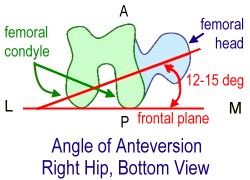
One of the keys in preventing unnecessary hip injuries is to have an in-depth understanding of the player’s anatomical/structural composition. In this regard, CAM impingement has received a lot of attention recently and rightfully so. Another frequent structural deviation that hasn’t received as much attention is femoral “version”. Femoral version is a measure of the angle of the femoral neck relative to a horizontal line through the two femoral condyles.

Demonstration of calculation of the angle of femoral version

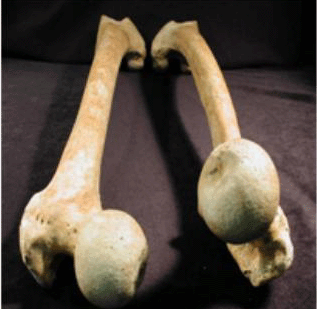
While I think the above cartoon schematic is instructive for understanding how femoral version is calculated, I think this picture from my friend Bill Hartman’s post (Hip Mobility: Femoral Anteversion) better illustrates the contrast between “normal” and excessive anteversion.

Can you imagine how the orientation of the knee, lower leg, and foot would change if the femur on the right was re-oriented so that the femoral neck was the same as the one on the left?

Excessive femoral version, in either direction, will have a significant effect on the performance of the entire body and a failure to recognize the presence of such a structural deviation may result in off-ice training exercises that appear “correct” externally to be damaging internally. As a result, it is worth the time to assess for femoral version angles in hockey players. Check out the video below for a quick walk through on how you can assess for excessive hip ante- or retro-version in just a few minutes.

An idea that didn’t come through sufficiently in the video is that EVERY femur has properties of ante- or retro-version. 8-15° is considered within normal limits and “excess” is generally considered anteversion > 30° and retroversion less than 5°. That said, any deviation outside of normal limits is going to have an effect on the availability of rotational movement. When I mentioned that I was thinking Matt’s left femur was retroverted and the right was anteverted (outside of the normal limits in those directions specifically), I probably should have said that left femur was more retroverted than right, or that his right was more anteverted than his left. Following Craig’s Test, it was apparent that his left femur was in fact “normal” (version within normal limits), but the right femur was anteverted.

An important take home from this assessment is that the total rotation ROM is the true indicator of unilateral limitations. Matt had more expressed external rotation ROM on the left than right, and more internal on the right than left, but the total rotation ROM between the two sides was relatively equivocal. This indicates that differences in either internal or external rotation ROM from one side to the other are either:

  1. An ossessous adaptation that should be recognized and appreciated, but cannot be corrected; or
  2. A positional change in the pelvic structures that causes a change in the expression of rotational ROM direction tendencies

In the case of the latter, Craig’s Test rules out that the findings of a tendency of a hip to have more internal or external rotation ROM in comparison to the other hip is a result of a change in the orientation of the pelvis because Craig’s Test is strictly a measure of femoral bony orientation relative to other femoral landmarks (pelvis is taken out of it altogether).

The assumption that all hips are created equally and that ROM norms can be blindly imposed on all hockey players is dangerously misguided. Of the first 30 elite level hockey players (primarily USHL, OHL, NCAA D1, and professional players)  I’ve assessed at Endeavor Sports Performance over the last few weeks, 10 (33%) have either a unilateral or bilateral femoral version angle outside of the norm. Spotting these structural deviations early will help prevent unnecessary damage directly to the femoroacetabular joint structures and indirectly to adjacent structures affected by rotational limitations at the hip. This is true during both on- and off-ice activities. By providing the player with an understanding of what corrective exercises they can do to maintain joint integrity and what positions/movements they should avoid, the player can stay within his/her individual limits, optimizing performance and minimizing injury risk.

To your success,

Kevin Neeld

Please enter your first name and email below to sign up for my FREE Athletic Development and Hockey Training Newsletter!
I hope you had a great week. We’re wrapping up another busy week at Endeavor. The hip assessments have spawned some interesting results that you’ll be interested to hear about in the future. Of the 20 guys I’ve tested, 1/4 have a structural abnormality that will absolutely need to be accounted for in their training, and the test is really easy to perform.

If you’re looking for an informative way to spend a few hours this weekend, we’ve posted a ton of stuff at Hockey Strength and Conditioning over the last few days. Check out what you’ve been missing!

Sean Skahan posted Phase 3 of his ACL rehab program. As Sean continues to post these progressions, it’s interesting to note that these don’t look like rehab prescriptions for a broken player. They look like a quality training program with some small pieces missing to account for the player’s injury. Hopefully this will continue to shed some light on the physical and mental efficacy of training around a player’s injury, and not just shutting the player down completely for the skeptics out there. Check out the program at the link below:

Click Here to Read >> ACL Rehab Phase 3 from Sean Skahan

My favorite Canadian David Lasnier had another terrific article posted on off-season hockey training. David has been on fire over the last month, as he’s had articles featured at StrengthCoach.com, SportsRehabExpert.com, and HockeyStrengthandConditioning.com (not bad for a guy who speaks English as a second language). All he needs now is to do a webinar for Anthony Renna’s LesWebinarsDeStrengthandConditioning.com and he’ll have officially “made it”! This article breaks down the complexities of off-season periodization into an easy to understand format that can be applied easily. This is the exact model we use to train our hockey players in the off-season at Endeavor Sports Performance.

Click Here for David’s Autograph>> Hockey Off-Season Periodization from David Lasnier

Mike Potenza posted an article outlining his philosophy on training throughout the playoffs. Whether you’re inclined to agree to disagree with his philosophy, I think he does a great job of pointing out that the NHL playoffs are far from short-lived. Those preaching to pack-in the training and basically do nothing at all may lose sight of the fact that, ideally, the team would be in the playoffs for about 3 months. Three-months of no training is sure to exacerbate hockey-related imbalances and detrain important physical capacities. Certain qualities (e.g. speed, conditioning) can be maintained well through on-ice work if it’s of sufficient intensity and duration. Other qualities will surely degrade (e.g. strength, power, structural balance). For some players, their confidence and overall durability are tied to certain physical qualities (e.g. strength), so it’s important not to overlook this when making decisions about late season and playoff training strategies.

Click Here to Read >> Playoff Training Model from Mike Potenza

Mike also added two videos on foam rolling and static stretching pairs, one for the upper body and one for the lower body (4 each). If you only have 5-10 minutes to get this work in, these series are good ones to follow.

Click Here to Watch >> Roller/Static Stretch Combos from Mike Potenza

Lastly, that Neeld guy slipped one past the guards and added an article on rotator cuff training for hockey players. This article highlights the most overlooked function of the rotator cuff and presents a few exercises to train it that you may not be expecting. In the interest of “prehab”, these exercises have extra value in that they aren’t isolative in training focus. In other words, they aren’t just “rotator cuff” exercises; they create a training effect for multi-directional core strength and stability, posture/movement pattern reinforcement and lower body strength (one of them).

Click Here to Read >> A New Look at Rotator Cuff Training

As always, the forums has been packed with some great discussions over the last couple days. When you sign into the site, be sure to check that out. Even in short threads, guys are posting videos and links to other resources that you won’t want to miss.  If you aren’t a member yet, shell out the $1 to test drive Hockey Strength and Conditioning for a week. If it’s not the best buck you’ve ever spent, I’ll personally refund you!

To your continued success,

Kevin Neeld

Please enter your first name and email below to sign up for my FREE Athletic Development and Hockey Training Newsletter!
Use CODE: "Neeld15" to save 15%