Great posts this week at Hockey Strength and Conditioning!

Article: Strength Training Takes on Many Forms from Sean Skahan

Awesome article from Sean. This is one of those “must-reads” for parents of young hockey players and any coach (or strength coach) that works with young players. Sean does a great job of explaining how we need to broaden our look on what strength training encompasses and how it will impact development.

Video: Goalie Plyo Variations from Mike Potenza

I’m always interested to see what other coaches are doing for goalies. Mike put together two video series of really interesting jumping progressions that he uses in San Jose. I really like the thought process behind these and will probably start to incorporate these exercises into my future programs for both players and goalies.

The forum has stayed pretty active with some great questions on the rationale for specific exercises (and their order) within bar complexes and some off-ice skating technique exercises.

Click the link below for more information about Hockey Strength and Conditioning!

To your continued success,

Kevin Neeld

Please enter your first name and email below to sign up for my FREE hockey training newsletter!

On Monday, I have a post about the whole “Death of the Squat” controversy that has taken the strength and conditioning industry by storm. I decided to delay that post until Monday because I recently came across an awesome video from my friend, colleague, and mentor Eric Cressey.

I’ve learned a lot from Eric’s approach to training, as he incorporates a lot of functional anatomy and lessons from physical therapy into his approach. Whether you think people should be squatting or not, this video is worth checking out. He walks through several mobility drills that are my “go-to” exercises for opening up the hips of our hockey players. The video is titled something like “7 Ways to Fix Your Squat”, but it should really be called “7 Awesome Hip Mobility Exercises for Athletes and General Fitness Enthusiasts”. Check it out at the link below:

>> FREE Access to Eric’s Awesome Hip Mobility Video <<

To your success,

Kevin Neeld

P.S. When you go to the link above, you will be asked to enter your name and email address to access the video. Don’t let this turn you off. Eric does this because he has other great videos to come and he wants to make sure he can notify you of their release. Gotta love exclusive content!

Please enter your first name and email below to sign up for my FREE Athletic Development and Hockey Training Newsletter!

Every now and then I’ll walk through Endeavor and see one of our players doing extra core work on their own. At first, this really intrigued me. We do SO much core work during the off-season I was flabbergasted that they’d want to do more.

The more I thought about it, the less surprised I was. Just about everyone that steps foot in a gym, hockey player or hockey parent (or, dare I say, someone NOT involved in hockey?), wants to have a more aesthetically appealing midsection. Despite the reality that having an appealing midsection is almost strictly a function of maintaining low levels of body fat (hence the guys with the muscle mass of Gumby with shredded “abs”), and decades of researching demonstrating that training a muscle group will not magically remove the fat above that muscle, the default practice is to lay down on the floor and do “abs” for 15 minutes at the end of every workout.


The resemblance is uncanny. (I apologize to any teenage girls that may be offended by this comparison)

Unfortunately, this will never, ever get them closer to having a six pack…ever. Eating better and learning lifelong nutritional strategies to optimize your health, performance, and body composition will (check out Brian St. Pierre’s site for more information on this stuff), but doing some extra ab work will not.

The bottom line though is that hockey players, like most people, feel better about themselves when they’re a little sore. Despite me pointing out that playing in traffic will also make you sore, most players opt for the extra core work. With that in mind, I thought it would be appropriate to put together a few quick “core” routines to help players in this regard, so they don’t just default to crunches, sit-ups, leg throw downs, Russian twists and other moronic core exercises.

Core Routine 1

A1) Slideboard Bodysaw: 2-3 x 8
A2) Bird Dog: 2-3 x (6x2s holds)/side
A3) Standing Cable Rotation: 2-3 x 8/side
A4) Stability Ball Knee Tucks: 2-3 x 8

Core Routine 2

A1) Rollouts (Stability Ball, Bar, or Ab Wheel): 2-3 x 8
A2) Standing Hip Flexed Dynamic Y->W’s: 2-3 x 10

A3) Tall Kneeling Belly Press: 2-3 x 10/side
A4) 1-Arm DB Farmers Walk: 2-3 x 50 yards/side

Core Routine 3

A1) Overhead Rotational Med Ball Floor Slam: 2-3 x 6/side
A2) 1-Leg Glute Bridge w/ Active Hip Flexion/Extension: 2-3 x 6-8/side
A3) 1/2 Kneeling Cable Chop: 2-3 x 10/side
A4) Slideboard Push-Up w/ 1-Arm Reach: 2-3 x 5/side


Hopefully this will give enthusiastic hockey players a framework from which to do their “extra” core work that still fits within the confines of my core training philosophy.

To your success,

Kevin Neeld

Please enter your first name and email below to sign up for my FREE Athletic Development and Hockey Training Newsletter!

This week was a little slower over at Hockey Strength and Conditioning, but there was still some great content.

Article: Interval Training Questions from Michael Boyle

This is a great Q&A from Boyle that covers some of the more frequently asked questions regarding interval training. His response to “the best way to calculate max heart rate” is both spot on…and comical.

Program: Training Camp Workouts from Mike Potenza

Seeing programs from other coaches, especially those as highly esteemed as Boyle, Potenza, and Sean Skahan is one of my favorite parts about being a member at HockeyStrengthandConditioning.com. You get to see EXACTLY how the coaches that have helped developed thousands of elite level players put together their programs at different times of the year, and if something doesn’t make sense, you can just hop over to the forum and ask them directly.

There is also a great discussion going on at the forum about how to design team training programs for different settings. This really resonated with me as we’re revamping our team programs at Endeavor for the dozen teams we have that play in the rink next door.

Click the link below for more information about Hockey Strength and Conditioning!

To your continued success,

Kevin Neeld

Please enter your first name and email below to sign up for my FREE hockey training newsletter!

I’ve had the opportunity to read/review most of the hockey training products out there and, to be honest, I’ve been largely unimpressed. Most are outdated, impractical, theoretical, or, well, minimally educated. When I’m reading through these hockey training products, I look for a balance of education and practicality. In other words, I look for detailed information on what a hockey player should be doing and why they should be doing it.

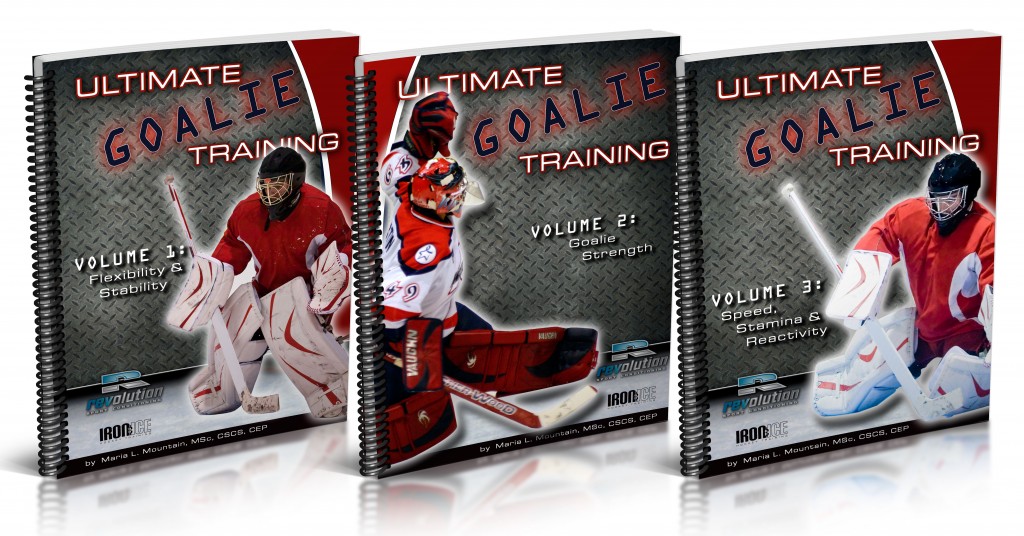
I recently read Maria Mountain’s Ultimate Goalie Training and was really impressed. Goalies are often overlooked in the training process. Maria’s training program did a great job of outlining the principles behind goalie training, exercises that goalies should be doing and why, and a program for goalies to follow. I was so impressed with the program that I asked Maria if she’d do an interview for us here at KevinNeeld.com.
KN: Goalie-specific training doesn’t receive much attention amongst the strength and conditioning world. Can you talk about the demands of being a goalie and why the position may deserve some special attention?

MM: Like many things in the strength and conditioning world the pendulum for goalie specific training swings to the extremes.  There are some practitioners who believe that goalies do not need anything different than the skaters.  I have also see practitioners who have their goalies actually wearing their pads while dropping off a high box onto a BOSU. They somehow feel that is creating a better goalie.  Personally, I would rather see a coach or trainer do nothing with their goalies than the latter routine.

I believe the goalie must be a great athlete first, but they do have some special needs.  With the butterfly style, goalies do need more hip internal rotation, they need to have good control of their hip adductors (groins) in a lengthened position to reduce the risk of adductor strains and they need more very short burst rapid lateral movements coordinated with hand-eye reaction.  Finally, when you consider the energy system demands on the goalie, they are quite different from a skater because the goalie will be on the ice for the entire game with sustained postures and then rapid bursts of movement.  So I prioritize my training for goalies by developing mobility, stability (in the hips and torso), strength, lateral speed and stamina.

The Ultimate Goalie Training system builds from a strong foundation up to the more dynamic goalie specific plyometric drills.  It is not a quick fix or a laundry list of exercises where goalies can pick their favorite exercises and do them over and over.  It takes the goalie through a logical step-by-step progression without any guesswork; I tell them what to do each day resulting in improved performance on the ice and reduced incidence of injury, so they can stay in the game.

KN: One of the limitations I see in a lot of training programs is that it’s hard to relay how to do the exercises with correct form. You do a great job of giving goalies everything they need to learn and perform the exercises. Can you explain for our readers how you went about doing this?

MM: In the Revolution Studio where I train athletes in London, Ontario I am extremely picky about technique.  I think we share a common philosophy on this Kevin in that if an athlete is not doing the exercise properly then they are not training the muscle groups they are trying to target.  Although it was very time consuming, my passion for perfect technique dictated that I videotape every exercise in the program with technical pointers.  I basically teach the goalie who is using the Ultimate Goalie Training system the same way I would teach an athlete in the gym.

Even if a goalie knows how to do squats for example, I want him/her to learn what is important to me from a technical perspective.  Again the goal is to maximize performance and reduce the risk of injury.  Once the goalie has viewed the videos, I also included ‘quick reference’ guides, which include photos of each exercise that they can put into their training manual and take along to the gym just in case they forget anything.  I have had goalies email me to say that they have loaded the videos onto their iPod – which I think is really cool, but please don’t ask me how to do it – I am proud of myself if I can buy a song on iTunes!

KN: One of the questions I get a lot from hockey players is “what exercise should I do for…?”. Can you talk about how you decided on the exercises to include and how you structured the program?

MM: When I create any program, the first question I always ask myself is “what am I trying to accomplish?”  Then I set about to create a program that will accomplish that goal in the least amount of time.  I see too many workouts that include 12-14-16 exercises (I actually saw one workout that had 21 exercises per strength workout – for three sets).  In my opinion, if you are including 21 exercises in a workout, you have no idea what you are trying to accomplish; you are throwing crap at the wall and hoping something sticks.

So with the Ultimate Goalie Training system I included the basics – remember goalies must be great athletes, so there are squats and squat variations because they need to build some great, strong, powerful legs.  Then I supplemented that with strength movements or power movements in other planes, which helps train similar patterns of muscle recruitment that the goalie may use on the ice.  So we are covering the big bang movements – the goalie gets stronger overall, and then I supplement with exercises to keep them mobile, nimble and injury resistant.  Not one exercise is included to help the goalie just look better; every exercise is either included to improve performance or reduce the risk of injury.  Any other fluff is cut – I don’t want someone wasting my time; so why would I waste the time of my athletes?

I also included an in-season training schedule and an off-season training schedule so the goalie knows exactly what to do each day regardless of where they are at in the season.  I tried to make it as step-by-step as possible while still providing an advanced training experience for the goalies that are serious about improving their performance.

KN: Thanks for taking the time Maria. Great stuff as always and a great resource for goalies to check out!

For more information on Maria’s Ultimate Goalie Training, check out UltimateGoalieTraining.com.

To your success,

Kevin Neeld

Please enter your first name and email below to sign up for my FREE Athletic Development and Hockey Training Newsletter!

Use CODE: "Neeld15" to save 15%