
In viewing the game demands for hockey goalies, it’s apparent they do not need the same focus on anaerobic capacity that is often essential for forwards and defensemen to integrate into their training programs.
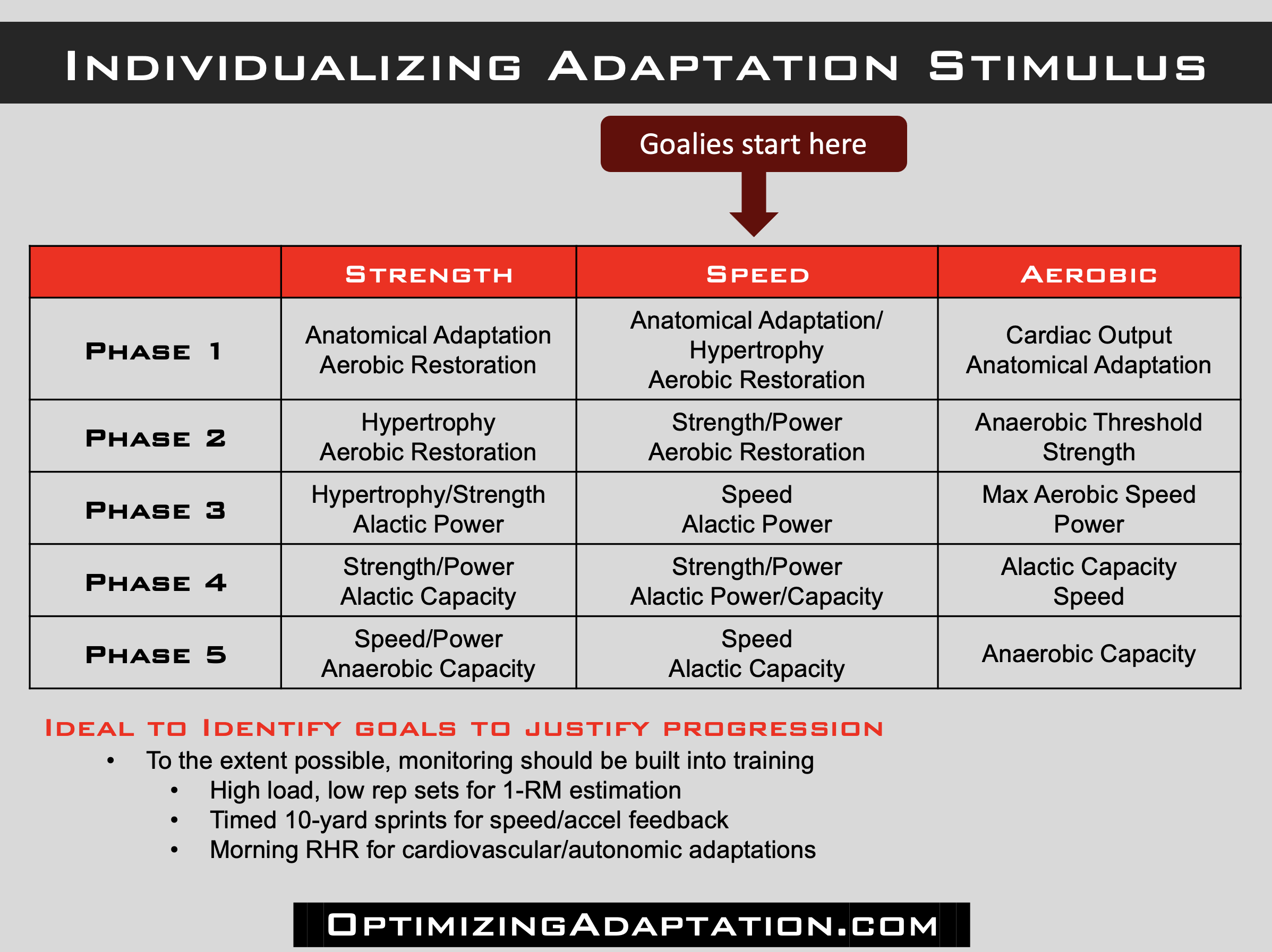
This picture is adapted from the “Performance Profiling as a Platform for Program Design” presentation I gave at our Optimizing Adaptation & Performance seminar, and shows examples of off-season training progressions for players with 3 different training goals.

As a general rule, goalies should follow the progression outlined in the Speed column. There are several unique features to this off-season progression, but the most notable is that when players transition to anaerobic capacity work (typically the last 2-3 weeks of the off-season), the goalies transition back into another speed phase.

Typically during the late off-season phases, goalies are also starting to spend more time on the ice, so the overall volume of off-ice work AND the emphasis on lateral movement should decrease.

Feel free to post any comments/questions below. If you found this helpful, please share/re-post it so others can benefit.

To your success,

Kevin Neeld
SpeedTrainingforHockey.com
HockeyTransformation.com
OptimizingAdaptation.com

P.S. For comprehensive hockey training programs to improve your speed AND repeat sprint ability, check out: Speed Training for Hockey
Enter your first name and email below to sign up for my FREE Sports Performance and Hockey Training Newsletter!

The goalie position has unique physical demands compared to forwards and defensemen that should factor into the training process.

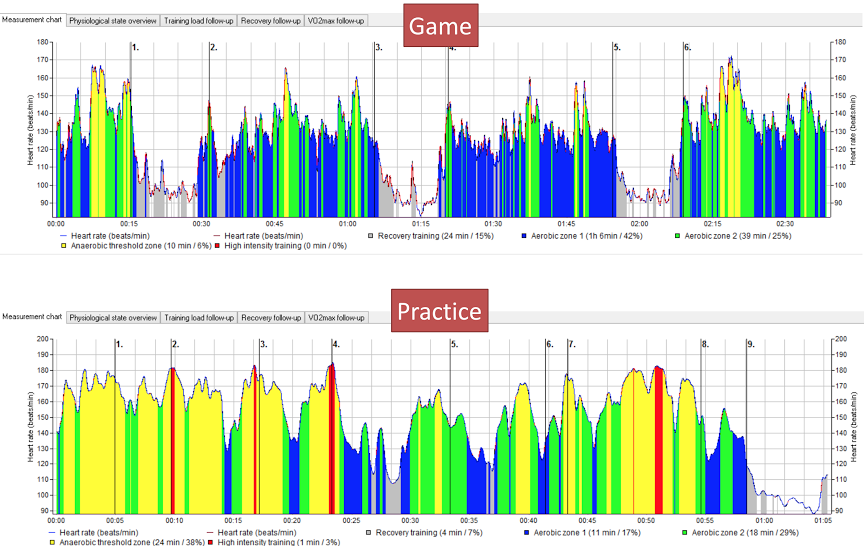
This image shows heart rate data (courtesy of @dmcconnell29) from a goalie in a game and a practice. Clearly there are differences in the conditioning demands in how goalies are being utilized in practices compared to games, but there’s another key takeaway:

Goalies are required to move at high intensities in short bursts, but generally not for sustained periods long enough to drive heart rate up, and then have LONG breaks to recover.

While there are some considerations for preparing goalies for “worst case scenarios”, goalies should really be trained more like sprinters – major focus on raising the ceiling for their speed/power, with supporting aerobic work to help with recovery and consistency.

Feel free to post any other comments/questions you have below. If you found this helpful, please share/re-post it so others can benefit.

To your success,

Kevin Neeld
SpeedTrainingforHockey.com
HockeyTransformation.com
OptimizingAdaptation.com

P.S. For comprehensive hockey training programs to improve your speed AND repeat sprint ability, check out: Speed Training for Hockey

Enter your first name and email below to sign up for my FREE Sports Performance and Hockey Training Newsletter!
Short duration maximum effort sprints on the Assault bike is an example of a conditioning strategy to improve repeat sprint ability by “raising the ceiling” (opposed to aerobic strategies that “raise the floor”).

The Assault bike is a great tool for this purpose because it’s a low skill movement, so the athlete can focus exclusively on output, and it provides objective feedback (speed or wattage) on the intensity for each rep.

Typically performed for 1-2 rounds of 8-10 reps of 6-10s sprints, starting on the minute (e.g. 50-54s of rest).

A key point of emphasis here is not letting the intensity drop significantly from the first to last rep. As a general rule, speed shouldn’t drop more than 5%. If the athlete can’t maintain that speed, then end the session if the goal was to do 1 round, or end the round and take a few minutes (3-5) to recover before starting the next round.

In this case, this is the only time I’ve seen a player max out the screens wattage (1999) on every rep. Incredibly impressive.

To your success,

Kevin Neeld
SpeedTrainingforHockey.com
HockeyTransformation.com
OptimizingAdaptation.com

P.S. For more information on in- and off-season program design, training and reconditioning for injured players, and integrating sports science into a comprehensive training process, check out Optimizing Adaptation & Performance

Enter your first name and email below to sign up for my FREE Sports Performance and Hockey Training Newsletter!
During the season, there are time when players should perform extra “conditioning” work.
 
When making daily decisions on how to design this type of work, it’s helpful to ask these 3 questions:
 
· What does the player need?
· What has the player done recently?
· How long does the player have to recover?
 
This will help identify the most impactful training goal, appropriate training method, and volume of work to help the player make progress while not negatively impairing the ability to compete the next day.

Feel free to post any other comments/questions you have below. If you found this helpful, please share/re-post it so others can benefit.

To your success,

Kevin Neeld
SpeedTrainingforHockey.com
HockeyTransformation.com
OptimizingAdaptation.com

P.S. For more information on in- and off-season program design, training and reconditioning for injured players, and integrating sports science into a comprehensive training process, check out Optimizing Adaptation & Performance

Enter your first name and email below to sign up for my FREE Sports Performance and Hockey Training Newsletter!

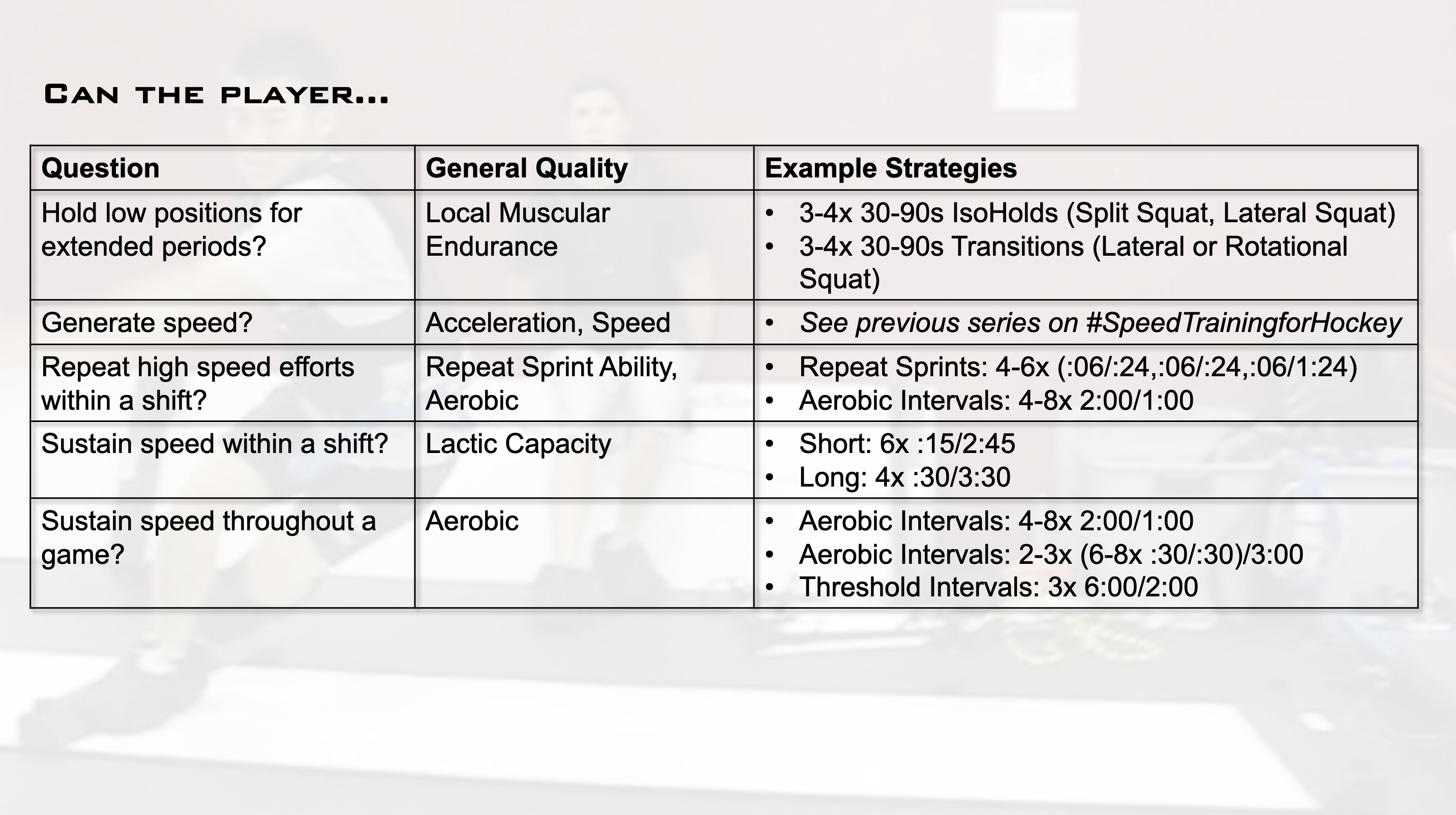
Different players will have different limiting factors to their conditioning. Answering these questions may help the player hone in on more specific strategies for their individual needs:

  1. Can the player hold low positions for extended periods of time? (see previous post for target times)
  2. Can the player generate speed? (see previous series for information on #SpeedTrainingforHockey)
  3. Can the player repeat high speed efforts within a shift?
  4. Can the player sustain speed within a shift?
  5. Can the player sustain speed throughout a game?

While it’s possible to address each of these things at the same time, it’s more effective to pick a target and focus on that.

For example, lactic capacity work, which will help improve within-shift sustainability, will compromise gains in speed and power. As a result, it’s better to train these qualities on different days, and preferably in different phases. 

In contrast, speed/power and repeat speed work can be trained on the same days, with aerobic work built into days between the higher intensity training sessions. 

As a general rule, players will benefit from following this hierarchy: Low Position Endurance -> Speed -> Repeat Sprint/Aerobic -> Lactic Capacity 

Feel free to post any other comments/questions you have below. If you found this helpful, please share/re-post it so others can benefit.

To your success,

Kevin Neeld
SpeedTrainingforHockey.com
HockeyTransformation.com
OptimizingAdaptation.com

P.S. For comprehensive programs to improve your speed AND repeat sprint ability, check out: Speed Training for Hockey

Enter your first name and email below to sign up for my FREE Sports Performance and Hockey Training Newsletter!

Use CODE: "Neeld15" to save 15%